Search results for: 'teen decides to be on camera'
-
-
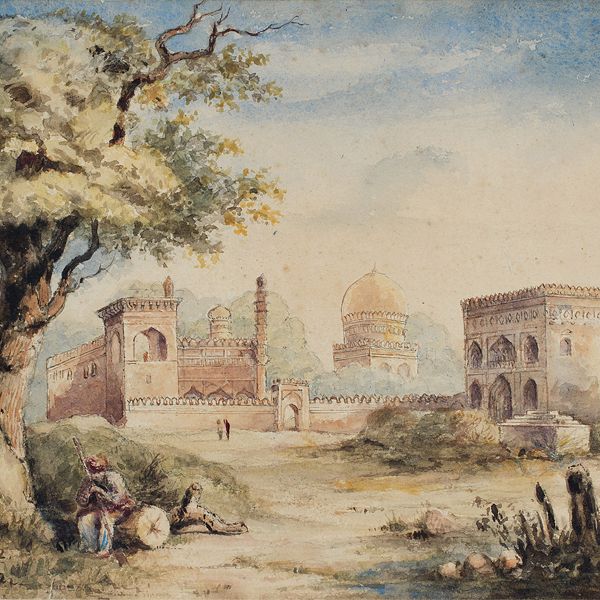
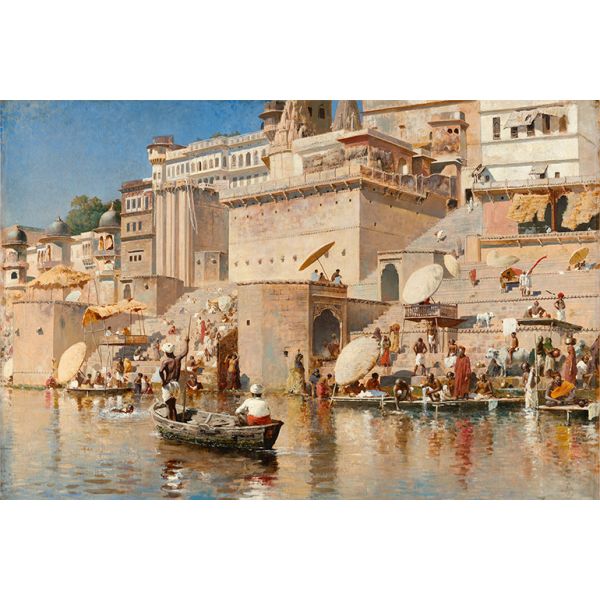 JournalOn the River Ganges, Benares by Edwin Lord Weeks$1.00
Let us take a moment to appreciate this magnificent riverside scene that can be instantly recognised as a view of Benares by the distinctive steep steps, or ghats, running down to the Ganga. American artist and Orientalist Edwin Lord Weeks had a remarkable ability to create an impression of a real-time scene unfolding before viewers, enhanced by the subtle plays of light and colour. A prolific artist who created a visual diary of his travels through his paintings—of which his India works are arguably his finest with an appeal that has transcended time.
Learn More -
 Institutional CollaborationsGhare Baire: The World, the Home and Beyond 18th – 20th Century Art in Bengal$1.00
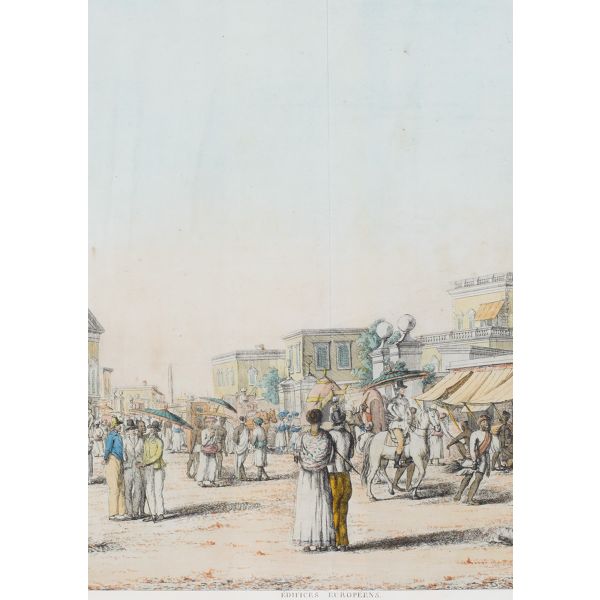
Ghare Baire was a museum-exhibition showcasing over 200 years of art in Bengal. Presented by DAG in collaboration with the National Gallery of Modern Art and the Archaeological Survey of India, the exhibition was housed at the historic Currency Building, across twelve galleries featuring over 700 artworks. The exhibition was the largest showcase of Bengal Art, presenting a panoramic view of the evolution of art in a region that has been critical to the development of Indian modern art. The exhibition starts with the arrival of the travelling European artists at a time of exchange between Bengal and the world. This confluence of cultures stimulated new visual languages as we see in the Kalighat pat, the Bengal School, and the subsequent emergence of artists who fearlessly and freely experimented with form and subject, reshaping the trajectory of art in India.
Learn More -
 ExhibitionsThe Art Of SantiniketanAs low as $1.00
The Art of Santiniketan showcases the work of its four chief artists—Santiniketan’s founder, Rabindranath Tagore, its first principal and the architect of the Santiniketan pedagogy, Nandalal Bose, and his two illustrious students who went on to make a name for themselves as highly original and significant artists—Benode Behari Mukherjee and Ramkinkar Baij. Santiniketan was a path-breaking educational institution Rabindranath Tagore set up in rural Bengal in the early twentieth century, and the exhibition begins by examining its genesis in Tagore’s radical ideas of basing education in freedom and in the midst of nature. Benode Behari Mukherjee Nandalal Bose Rabindranath Tagore Ramkinkar Baij
Learn More -
-
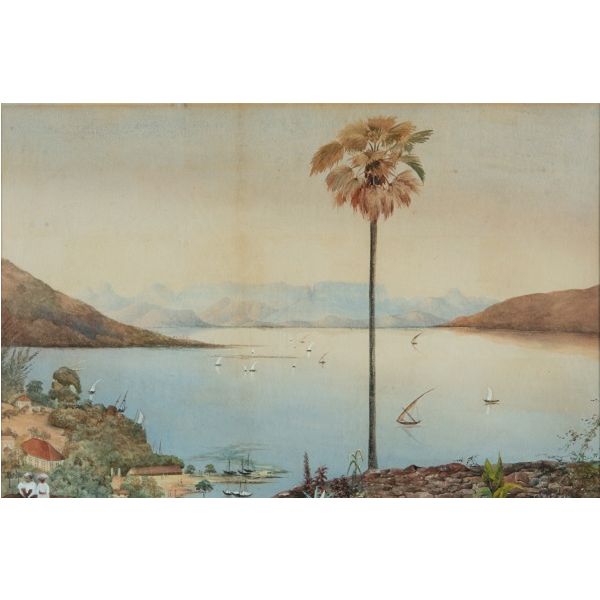 JournalBombay through the eyes of European Artists$0.00
The city was consolidated over the course of the eighteenth century, and its access to global trade routes helped it grow over the following centuries as well, leading some to describe it as the 'door of the East with its Face to the West'. How did European artists view this growing city?
Learn More -
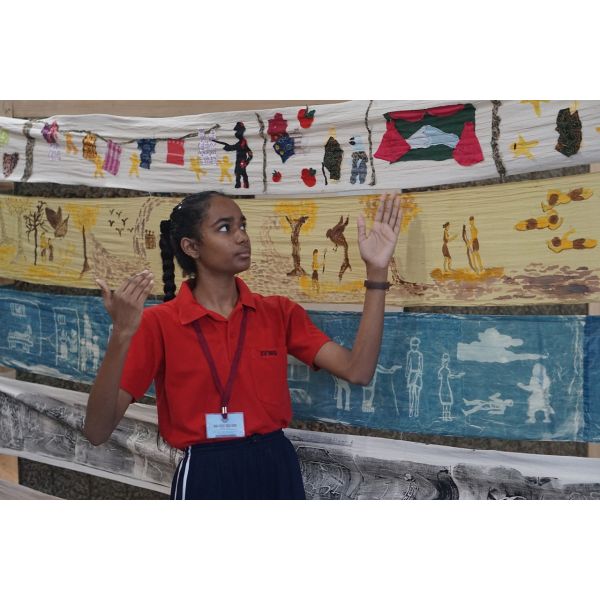 JournalFabric of Freedom: The struggle for independence through art$0.00
To celebrate Independence Day a little differently, we worked with students of Indus Valley World School to create an exhibition using the artworks from the DAG collection.
Learn More -
 ExhibitionsAmitava: The Complete WorksAs low as $1.00
In a career spanning four decades, Amitava’s location as an artist has determined the authority that he brings to his practice. As an artist studying and working in the 1960s, Amitava Das experienced a decade of fragmented locii. The ’60s, the period of his education at the College of Art, was the decade of wars, fiscal difficulty and an uncertain polity in the wake of the death of Jawaharlal Nehru. Further, as a second generation pravasi (non-residing Indian) Bengali, the roiling political violence of West Bengal’s Naxal movement came to him through the filter of poetry, film and art—much as he would have received the existential writing of Camus, Genet and Rilke. Through the 1960s and ’70s, small groups of artists and filmmakers in different pockets in India had a heightened response: the state of the nation found an uncanny echo in the language of modernism, of the artist’s isolation and purity even within a state of uncertainty.
Learn More -
 ExhibitionsIndian BlueAs low as $1.00
The colours we see around us are a complex network of visual signifiers. Like spoken dialects, each colour contains multiple—at times conflicting—meanings that are moulded by a universal base and many regional variances. A. A. Almelkar A. H. Müller A. P. Santhanaraj Abalall Rahiman Abanindranath Tagore Ahmed Amir Altaf Ambadas Amit Ambalal Amitava Anonymous Anupam Sud Avinash Chandra Benode Behari Mukherjee Bijan Choudhary Biren De Bireswar Sen Bishamber Khanna Bishnupada Roy Chowdhury Chittaprosad D. C. Joglekar D. P. Roy Chowdhury Dattatraya Apte Devayani Krishna Devraj Dakoji Dharamanarayan Dasgupta F. N. Souza G. R. Iranna G. R. Santosh G. S. Haldankar Ganesh Haloi Gobardhan Ash Gogi Saroj Pal Hemanta Misra Himmat Shah Indra Dugar Indu Rakshit J. P. Gonsalves J. Sultan Ali Jamini Roy Jeram Patel Jogen Chowdhury Jyoti Bhatt K. C. S. Paniker K. K. Hebbar K. Laxma Goud K. S. Kulkarni Kanwal Krishna Kavita Nayar Krishna Reddy Lalit Mohan Sen Laxman Pai M. F. Husain M. K. Parandekar M. R. Acharekar M. S. Joshi Madhvi Parekh Manu Parekh Nand Katyal Nandalal Bose Natvar Bhavsar Navjot Nicholas Roerich Nikhil Biswas Om Prakash P. Khemraj Paramjit Singh Paresh Maity Paritosh Sen Partha Pratim Deb Prabhakar Barwe Prokash Karmakar Rabin Mondal Radha Charan Bagchi Ramendranath Chakravorty Ramgopal Vijaivargiya Ramkinkar Baij Ranen Ayan Dutta S. H. Raza S. K. Bakre S. L. Haldankar Sanat Chatterjee Sanat Kar Sankho Chaudhuri Satish Gujral Shanti Dave Shobha Broota Somnath Hore Sudhir Khastgir Sunayani Devi Sunil Das V. B. Pathare Vasundhara Tewari Broota Vivan Sundaram Walter Langhammer
Learn More