Search results for: 'hindu woman on her knees'
-
 ExhibitionsWays of SeeingAs low as $1.00
Do we view things differently as we grow older? What are the perspectives that matter most when viewing art? Do we see things differently as men and women? Do we see art differently as men and women? How does one’s gender impact the creation of art? In the months leading up to ‘Ways of Seeing’, these were some of the questions we posed to ourselves, and we wish we could say that we found a generic, universal response, for there are as many standpoints and views as there are viewers and people. Amrita Sher-Gil Anjolie Ela Menon Anupam Sud Arpana Caur B. Prabha Devayani Krishna Elizabeth Brunner Gogi Saroj Pal Jaya Ganguly Kanchan Chander Kavita Nayar Latika Katt Madhvi Parekh Mrinalini Mukherjee Nalini Malani Navjot Nilima Sheikh Rekha Rodwittiya Shobha Broota Sunayani Devi Vasundhara Tewari Broota Zarina Hashmi Akbar Padamsee Avinash Chandra B. C. Sanyal Baburao Painter Bikash Bhattacharjee D. P. Roy Chowdhury Dharamanarayan Dasgupta Dhruva Mistry F. N. Souza G. R. Santosh Ganesh Pyne George Keyt Haren Das Jagadish Dey Jamini Roy Jogen Chowdhury Jyoti Bhatt K. H. Ara K. S. Kulkarni Khagen Roy Krishen Khanna M. F. Husain M. Suriyamoorthy M. V. Dhurandhar Nandalal Bose P. T. Reddy Prokash Karmakar Sakti Burman Satish Sinha Sudhir Khastgir Sunil Das V. Nageshkar
Learn More -
 ExhibitionsPrimitivism & Modern Indian ArtAs low as $1.00
This exhibition looks at the diverse range, moods and styles that primitivism has taken in India, some artists practicing entirely in that style, while others experimenting with it in part, or sporadically. One can count simplicity and a move away from sophistication as key components, as also an inclination or at least a nod towards the folk. The exhibition does not attempt to be a comprehensive survey of India’s primitivists—there are others who would bear inclusion—but is an attempt to understand a body of work and how, given its Western countenance, it can be understood in the Indian context. More than anything else, it offers a clearer view than in the past of what primitivism might mean in the context of modern Indian art. Amrita Sher-Gil F. N. Souza George Keyt Himmat Shah J. Sultan Ali Jamini Roy Jogen Chowdhury K. G. Subramanyan K. S. Kulkarni M. F. Husain Madhvi Parekh Mohan Samant Rabin Mondal Rabindranath Tagore Ramkinkar Baij Sunayani Devi
Learn More -
 ExhibitionsWilliam Hodges & the Prospect of IndiaAs low as $1.00
William Hodges (1744-97) was a pioneer in more ways than one. He was the first British landscape painter to visit India, and to portray scenery across the whole breadth of the Gangetic plain. As a writer, he gave the first detailed descriptions of numerous historic Indian buildings, and he theorised about the origins and evolution of Indian architectural design. His art illustrates his exploration into terrain which—in its breadth and scope—was at the time almost as unfamiliar to Indian as to Western eyes.
Learn More -
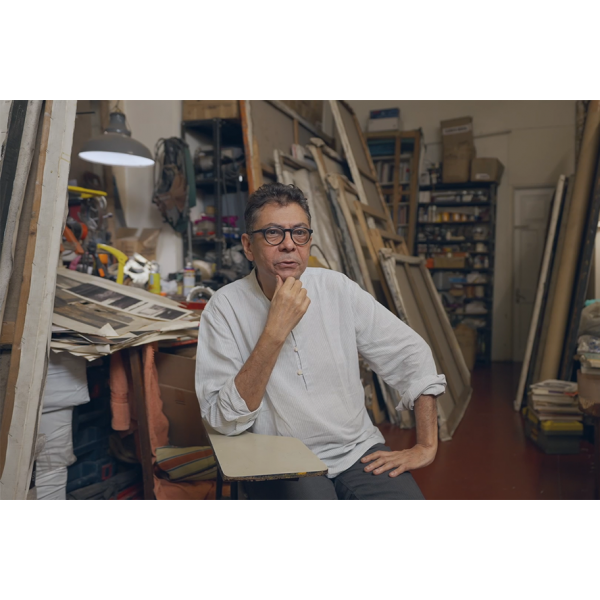 JournalChittrovanu Mazumdar on Nirode Mazumdar$0.00'Iconic Masterpieces of Indian Modern Art, Edition 2' opened on 11 February, featuring fifty artworks which shaped the trajectory of pre-modern and modern art in the country. As part of the exhibition, Chittrovanu Mazumdar explores the sense of rhythm in his father Nirode Mazumdar’s ‘Boitorini Series’, drawing attention to how its controlled colour palette depicts the flow of life in the metaphor of a river that one must cross during one’s lifetime. Learn More
 -
 ExhibitionsThe World Will Go OnAs low as $1.00
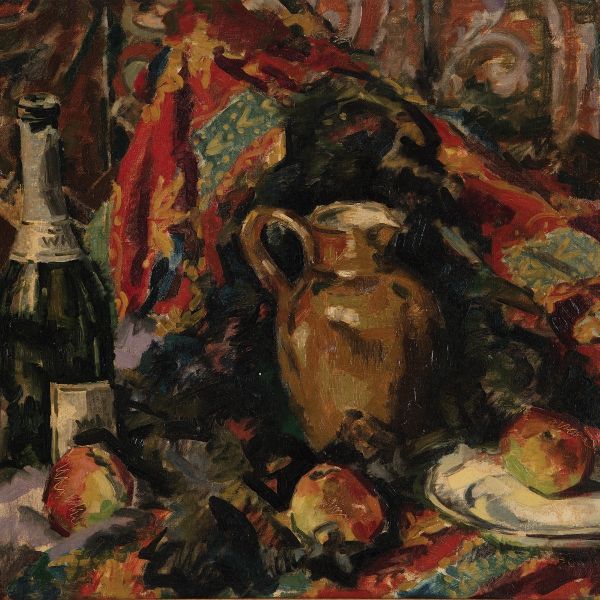
2020 marks a special year in mankind’s history and India’s destiny. Often used in reference to development goals, 2020 has taught us to never take things for granted. While humanity has made major leaps, even conquering outer space, nature has shown us how little we know about it, and how little we appreciate what we have. 2020 has taught us to review our values. We have suffered but also been comforted, and we have learned to acknowledge that irrespective of our joys and sorrows, our triumphs and our failures, the world will not stop, it will go on. Husain Rabin Mondal Santosh Jehangir Sabavala Mohan Samant Swaminathan Paramjit Paramjeet Ramgopal Vijaivargiya Seal Singh Dasgupta Haren Das Shanti Dave Jagadish Dhanapal Dhurandhar Bipin Behari Goswami Laxma Goud George Keyt Ara Nandalal Bose Jyoti Bhatt Natvar Bhavsar Eric Bowen Shobha Broota Avinash Chandra Sanat Chatterjee Shiavax Chavda Hebbar Khemraj Krishen Khanna Walter Langhammer Jeram Patel Aroomogam Pillay Raza Reddy Jamini Roy Vasudev Viswanadhan Manu Madhvi Parekh Laxman Pai Dhirendra Narayan Dharamanarayan.
Learn More -
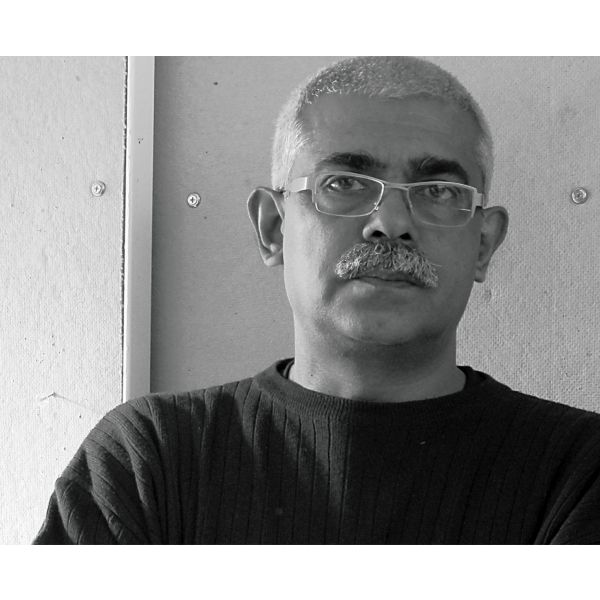 ArtistsSurendran Nair$0.00Born in Onkkoor, Kerala, Surendran Nair graduated in painting from College of Fine Arts, Trivandrum, in 1982, and studied printmaking from M. S. University, Baroda, in 1986. Nair began his art practice with strongly realist pen and ink drawings, etchings and lithographs, and commemorated people from his immediate surroundings or literary heroes in his portraiture. Learn More
 -
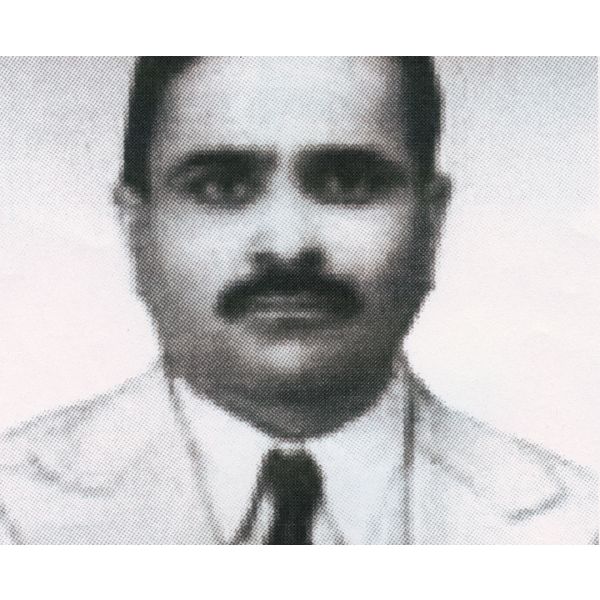 ArtistsD. C. Joglekar$0.00Exemplifying the art of the now-forgotten Bombay School, which was based on realism, or naturalism, as taught by the British, D. C. Joglekar was one of the finest artists who captured India’s panoramic landscapes along with her glorious architectural wonders, including temples, monuments, and archaeological sites. Learn More
 -
-
-
 Institutional CollaborationsMARCH TO FREEDOM: REFLECTIONS ON INDIA'S INDEPENDENCE$1.00
March to Freedom re-interprets the well-known story of the Indian freedom struggle and anticolonial movement through works of art and some historic artefacts. Drawn from the collections of DAG, they range from eighteenth and nineteenth century European paintings and prints, to lesser known works by Indian artists that merit greater recognition, alongside some iconic pieces. Rather than following the usual chronological path, the story is structured around eight themes. Each represents one arena, or stage, on which the anti-colonial struggle took place, to expand the story beyond politics, politicians, and battles (which also feature). Conceived to commemorate and celebrate the 75th anniversary of India’s independence, this visual journey seeks to do more. For even as we remember the struggles, the sacrifices, and the stories, such anniversaries are also occasions for reflection, including upon the scholarship that has developed on South Asian history. Some of the latter may be familiar to academics, or those with special interests. For most of the rest of us, our knowledge of this past is derived in large part from hazy memories of school lessons, which change from one generation to the next, and are influenced by concurrent national politics. We also learn from narratives on offer through public channels or in the media, to mark moments of national remembrance or controversy.
Learn More -
 Art FairsArt Dubai$0.00
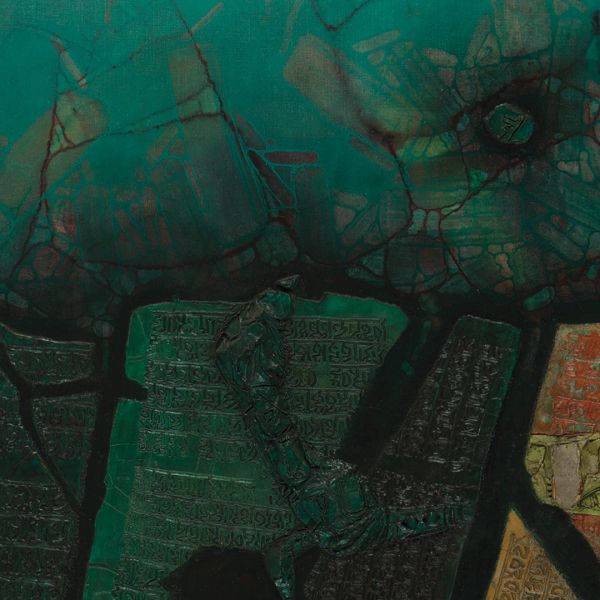
Shanti Dave’s abstracts resemble—at first—the familiar and the unknown. There are writings, figures, deities, forms and shapes that resonate with what we seem to know. If the language is indecipherable, perhaps it belongs to some ancient texts lost to history. Is this his ode to a civilisation that existed in the past, or a prophesy of one to come? Is it a world hidden underwater? Or perhaps one alien to us because it comes from some other planet? Are these tombstones, or markers, of some mythological or historical realm?
Learn More