


Search results for: 'why did no one in gossip girl go to yale'
-
 Institutional CollaborationsDRISHYAKALA$1.00
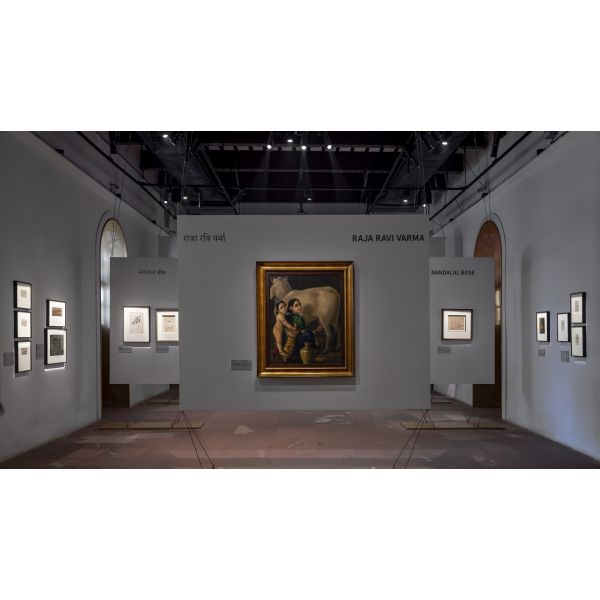
How did the multiple trajectories of visual arts develop in the subcontinent? Where did they originate and how did their paths converge? Drishyakala offers a sweeping journey into the heterogenous histories of visual arts in India, from the first European travelling artists who drew landscapes to popular prints of the earliest woodcuts and lithographs evolving into the thriving advertising visuals of the 20th century. The exhibition is broadly divided into four categories, each exploring an unique area of development—the art of portraiture through photography and painting, oriental sceneries drawn by European travelling artists, popular prints from the late eighteenth century to post-independence and artworks of the nine National Treasure Artists. Together, these sections give brief glimpses into the dizzying variety of forms, styles and languages of South Asian art.
Learn More -
 ExhibitionsTantra on the EdgeAs low as $1.00
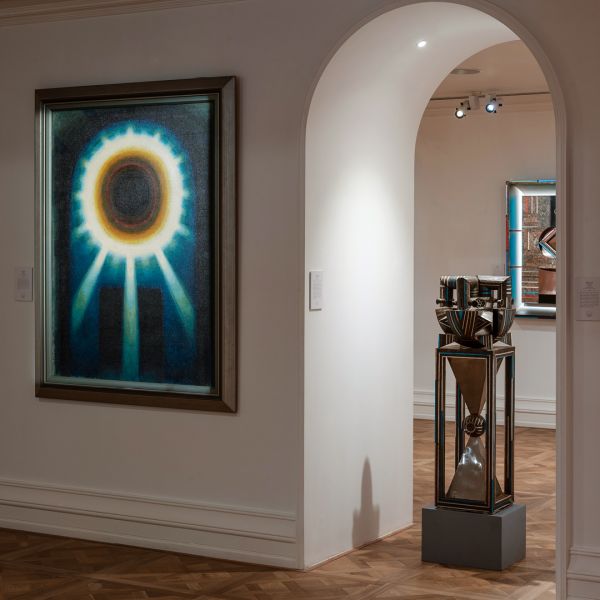
The exhibition Tantra on the Edge: Inspirations and Experiments in Twentieth Century Indian Art is a pioneering attempt to gather together works of sixteen prominent Indian artists under the single thematic rubric of the transient but least definable phases of contemporary art in the last century. The exhibition features the artworks, inspirations, and experiments, of artists that had a sustained relationship with tantra philosophy, its vivid, abstract, sacred symbols, or their personal spiritual illuminations. Biren De G. R. Santosh Gogi Saroj Pal J. Swaminathan Jyoti Bhatt K. C. S. Paniker Manu Parekh P. T. Reddy Prabhakar Barwe R. B. Bhaskaran S. H. Raza Satish Gujral Shobha Broota Sohan Qadri Sunil Das V. Viswanadhan
Learn More -
 ExhibitionsThe Gold SeriesAs low as $1.00
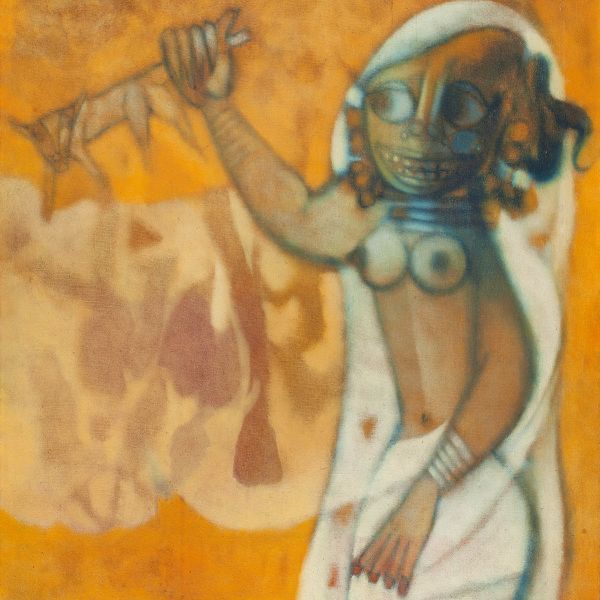
When we launched the Silver Series in May 2020 as our attempt to stay engaged with art-lovers no longer able to visit our galleries, we were unsure of the response. But the feedback we received was heartening, and it was backed by commensurate sales to prove that the art-loving fraternity supported the initiative and gave it a resounding thumbs-up. J. Sultan Ali Altaf Amit Ambalal Amitava Anonymous (Early Bengal) Anonymous (Kalighat Pat) Anonymous (Portraiture) K. H. Ara Prabhakar Barwe Bikash Bhattacharjee Nikhil Biswas Nandalal Bose Eric Bowen Shobha Broota Sakti Burman Avinash Chandra Jogen Chowdhury Sunil Das Prodosh Das Gupta Shanti Dave Rajendra Dhawan M. V. Dhurandhar K. Laxma Goud Satish Gujral Zarina Hashmi K. K. Hebbar M. F. Husain George Keyt Krishen Khanna K. S. Kulkarni Ram Kumar Rabin Mondal S. Nandagopal Laxman Pai Gogi Saroj Pal Madhvi Parekh Jeram Patel Ganesh Pyne Sohan Qadri A. A. Raiba S. H. Raza P. T. Reddy Rekha Rodwittiya Jamini Roy G. R. Santosh Paritosh Sen F. N. Souza Anupam Sud Ramgopal Vijaivargiya
Learn More -
-
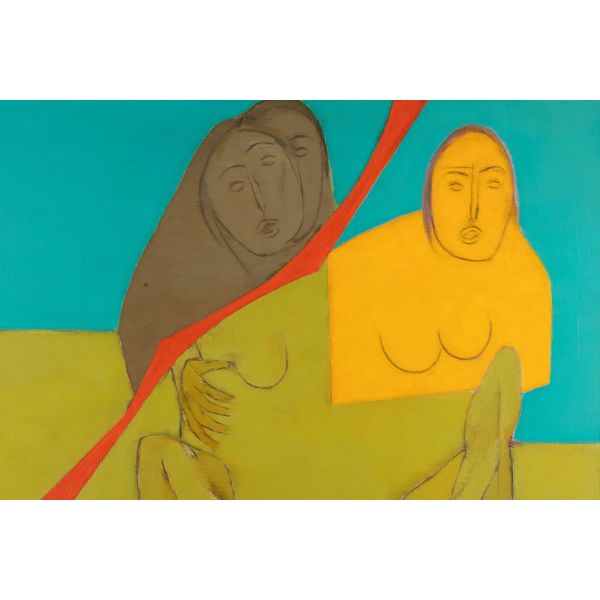 JournalTerm Of The Month: The Diagonal Method$0.00
As one of India’s most well-known artists, Tyeb Mehta still commands our attention for his commitment to experimentation. His ‘Diagonal series’ established him as a dynamic figure within the world of modern art, but how did this diagonal method come to be an important tool of composition in the last century? It all started with the invention of another compoitional tool called the 'rule of thirds'. Read below as we explore the origins of this artistic tool and see how it has evolved over time.
Learn More -
 ExhibitionsNew Found LandsAs low as $1.00
We might think of landscape as the most obvious and natural subject for painting. What could be simpler than an artistic response to the world of nature? And yet, civilisations have not always produced landscape paintings. Landscape as an independent genre—with the primary focus not on action but on scenery—was first championed by the Chinese in the ninth century. It was introduced into English art only in the eighteenth century. Elements of nature have appeared in Indian art since the murals of Ajanta, but in supporting roles, in images that are primarily sacred or courtly. Pure landscape painting arose in India only in the nineteenth century, in response to colonial practice. A A ALMELKAR AVINASH CHANDRA BABURAO SADWELKAR BHUNATH MUKERJEE BIJAN CHOUDHARY BIRESWAR SEN CHITTAPROSAD DEVRAJ DAKOJI DEVYANI KRISHNA DHARAMANARAYAN DASGUPTA GANESH HALOI GOBARDHAN ASH HAREN DAS K. K. HEBBAR KANWAL KRISHNA KISORY ROY M. K. PARANDEKAR M. V. DHURANDHAR MANISHI DEY MUKUL DEY New Found Lands NIKHIL BISWAS PESTONJI E BOMANJI PRAN KISHAN PAUL RABIN MONDAL RAMENDRANATH CHAKRAVORTY RAMKINKAR BAIJ SAKTI BURMAN SUNIL DAS THOMAS DANIELL WILLIAM HODGES WILLIAM PARKER
Learn More -
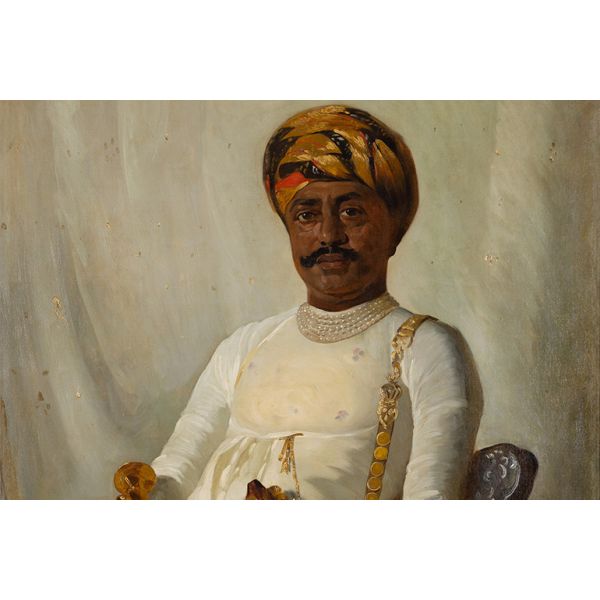 JournalThakor Becharsinhji of Chuda by Frank Brooks$1.00
Did you know that the portrait painter Frank Brooks whose two trips to India won him commissions from the rulers of principalities in the Bombay Presidency, trained Raja Ravi Varma’s brother in the art of figure painting? For his second India voyage (1892-93), he was invited specially to paint the heads of the twenty-eight rulers of the Kathiawar Agency. The subject of this stunning portrait is Thakur Becharsinhji of Chuda, a state so small it did not even merit a gun salute for its ruler. Explore in detail with Kishore Singh, SVP, DAG.
Learn More -
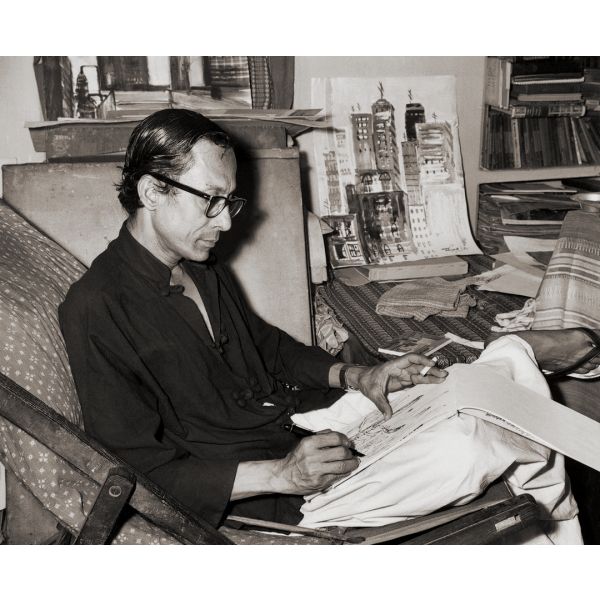 ArtistsGopal Ghose$0.00An ‘India wanderer’, as he liked to call himself, Gopal Ghose spent his formative years away from Calcutta, where he was born on 5 December 1913. His art training began at the Maharaja School of Arts, Jaipur. From 1935-38, Ghose studied at the Government College of Art and Craft, Madras. Once, while painting on the Marina beach in Madras, he caught the attention of C. Rajagopalachari—statesman, activist, writer and leader of the Indian National Congress—who offered to arrange his further studies abroad, which the college authorities, however, did not permit. Learn More
 -
 ExhibitionsIndia ModernAs low as $1.00
Any new exhibition brings with it a frisson of excitement, but by any measure India Modern: Narratives From 20th Century Indian Art has been extra special. Most art lovers take Indian modernism for granted—but how many can truly claim to know what it really means. For too many years, the term has been loosely used, with very little awareness of what it includes, or omits. What the West understands and takes as a given is something that in India still remains a mystery, perhaps because art in India cannot strictly be viewed from the same trope as Western art. Perhaps this is true of most countries, but it is especially true of colonised nations where new engagements with art in the West were imposed without the benefit of growing their own local practices organically. This hybrid custom developed at various levels, which makes it exciting when viewed from some distance, but also imposes a challenge. Therefore the question: What does modernism in Indian art imply? Akbar Padamsee Ambadas Anjolie Ela Menon Avinash Chandra B. Prabha Bikash Bhattacharjee Bimal Dasgupta Biren De Dhanraj Bhagat Dharamnarayan Dasgupta F. N. Souza G. R. Santosh Ganesh Haloi Ganesh Pyne George Keyt Gieve Patel H.A. Gade Himmat Shah J. Sultan Ali J. Swaminathan Jehangir Sabavala Jeram Patel Jogen Chowdhury K. G. Subramanyan K. H. Ara K. K. Hebbar K. S. Kulkarni Krishen Khanna Laxman Goud Laxman Pai M. F. Husain Manjit Bawa P. Khemraj P.T. Reddy Rabin Mondal Ram Kumar S. K. Bakre S.H. Raza Sakti Burman Sohan Qadri Somnath Hore Sunil Das
Learn More -
 ExhibitionsSoliloquies of SolitudeAs low as $1.00
The mid-twentieth century saw a churn in the practice of art in India with a number of artists beginning to explore a genre that had swept the West with its absence of figuration in favour of abstraction. The non-representational began to gain traction as artists found within it a way to express themselves purely through colour as a potent tool to communicate emotions. Abstraction emphasised the relationship between originality and expression in ways that were complex, leading one to debate about the eventual goal of art. Ambadas, Krishna Reddy, Sohan Qadri, Zarina Hashmi, Rajendra Dhawan
Learn More -
 ExhibitionsPrimitivism & Modern Indian ArtAs low as $1.00
This exhibition looks at the diverse range, moods and styles that primitivism has taken in India, some artists practicing entirely in that style, while others experimenting with it in part, or sporadically. One can count simplicity and a move away from sophistication as key components, as also an inclination or at least a nod towards the folk. The exhibition does not attempt to be a comprehensive survey of India’s primitivists—there are others who would bear inclusion—but is an attempt to understand a body of work and how, given its Western countenance, it can be understood in the Indian context. More than anything else, it offers a clearer view than in the past of what primitivism might mean in the context of modern Indian art. Amrita Sher-Gil F. N. Souza George Keyt Himmat Shah J. Sultan Ali Jamini Roy Jogen Chowdhury K. G. Subramanyan K. S. Kulkarni M. F. Husain Madhvi Parekh Mohan Samant Rabin Mondal Rabindranath Tagore Ramkinkar Baij Sunayani Devi
Learn More -
 ExhibitionsThe HindusAs low as $1.00
Among all attempts by foreign artists to present a complete view of India, none is so focused on people as the work of François Baltazard Solvyns, who lived in Calcutta for a decade starting in 1791. While picking up odd jobs, he embarked on an ambitious project to produce a comprehensive survey of ‘the manners, customs, and dresses, of the Hindus’. The first edition contained 250 hand-coloured etchings and was published by Solvyns between 1796 and 1799.
Learn More