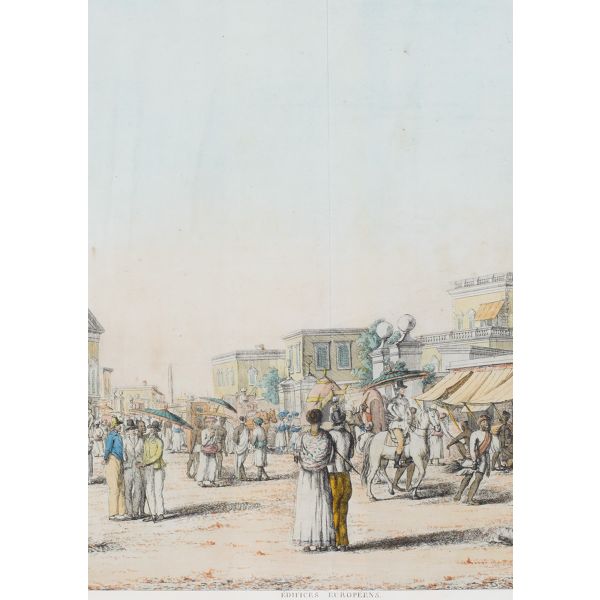
Search results for: 'Make Me A Pallet On Your Floor written by'
-
 JournalThe Last Effort and Fall of Tippoo Sultaun by Henry Singleton$1.00
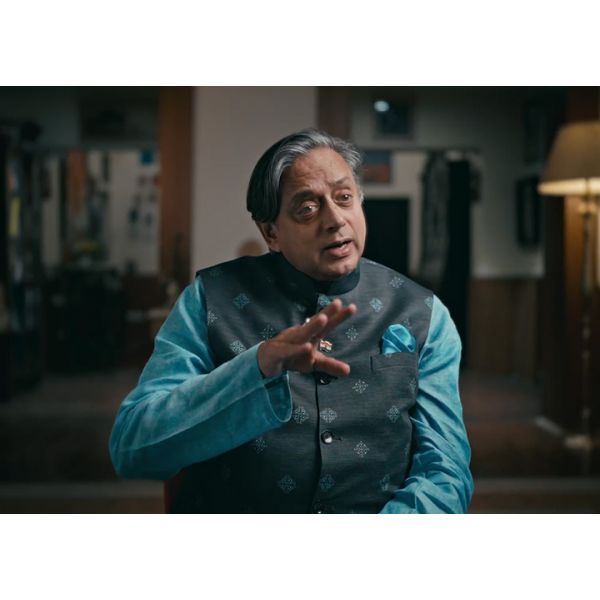
Henry Singleton’s The Last Effort and Fall of Tippoo Sultaun belongs to a genre known as history painting: the depiction of important historical events, usually on a large scale, as if they were playing out in front of one’s eyes. Author and parliamentarian Shashi Tharoor and art historian Giles Tillotson explain the lively imagination deployed in Singleton’s painting that depicts the British assault on Seringapatam and the killing of its ruler, Tipu Sultan—himself the source of so many stories that it was difficult to unravel the truth from the many falsities spun by the biased colonial administration and historians of the time.
Learn More -
 JournalSketching a Temple: Nandalal Bose’s Konark album$0.00
One of India’s nine national treasure artists, Nandalal Bose (1882—1966) forged a long and glittering career as the foremost artist-pedagogue bridging the late-colonial period and the first few decades after Indian independence. He maintained an active drawing practice throughout his life, with many small sketches done on postcards that he carried around with him as a sort of visual notebook.
Learn More -
 Collection StoriesThe Afterlife of the Taj Gardens: Changes in the Landscape$1.00
Often described as ‘Poetry in Stone’, the Taj Mahal was laid out between 1631-43 by Mughal Emperor Shah Jahan as a mausoleum for his wife Mumtaz Mahal. It is the architectural elements of the Taj complex that grab the most attention, but in fact the garden is the heart of the complex . The visitors today are so transfixed by the Taj itself that they remember very little of the garden. DAG Archive attempts to illustrate the life and ‘afterlife’ of the Taj gardens, once its control was taken over by the British. This archive deep dive showcases the objects from A. E. P. Griessen’s (1875–1935) collection.
Learn More -
 ExhibitionsIndian BlueAs low as $1.00
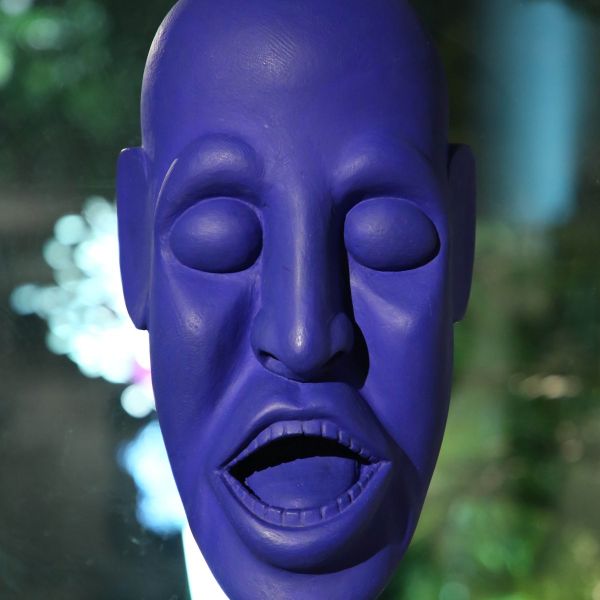
The colours we see around us are a complex network of visual signifiers. Like spoken dialects, each colour contains multiple—at times conflicting—meanings that are moulded by a universal base and many regional variances. A. A. Almelkar A. H. Müller A. P. Santhanaraj Abalall Rahiman Abanindranath Tagore Ahmed Amir Altaf Ambadas Amit Ambalal Amitava Anonymous Anupam Sud Avinash Chandra Benode Behari Mukherjee Bijan Choudhary Biren De Bireswar Sen Bishamber Khanna Bishnupada Roy Chowdhury Chittaprosad D. C. Joglekar D. P. Roy Chowdhury Dattatraya Apte Devayani Krishna Devraj Dakoji Dharamanarayan Dasgupta F. N. Souza G. R. Iranna G. R. Santosh G. S. Haldankar Ganesh Haloi Gobardhan Ash Gogi Saroj Pal Hemanta Misra Himmat Shah Indra Dugar Indu Rakshit J. P. Gonsalves J. Sultan Ali Jamini Roy Jeram Patel Jogen Chowdhury Jyoti Bhatt K. C. S. Paniker K. K. Hebbar K. Laxma Goud K. S. Kulkarni Kanwal Krishna Kavita Nayar Krishna Reddy Lalit Mohan Sen Laxman Pai M. F. Husain M. K. Parandekar M. R. Acharekar M. S. Joshi Madhvi Parekh Manu Parekh Nand Katyal Nandalal Bose Natvar Bhavsar Navjot Nicholas Roerich Nikhil Biswas Om Prakash P. Khemraj Paramjit Singh Paresh Maity Paritosh Sen Partha Pratim Deb Prabhakar Barwe Prokash Karmakar Rabin Mondal Radha Charan Bagchi Ramendranath Chakravorty Ramgopal Vijaivargiya Ramkinkar Baij Ranen Ayan Dutta S. H. Raza S. K. Bakre S. L. Haldankar Sanat Chatterjee Sanat Kar Sankho Chaudhuri Satish Gujral Shanti Dave Shobha Broota Somnath Hore Sudhir Khastgir Sunayani Devi Sunil Das V. B. Pathare Vasundhara Tewari Broota Vivan Sundaram Walter Langhammer
Learn More -
 JournalTerm of the Month: Figure Drawing$0.00
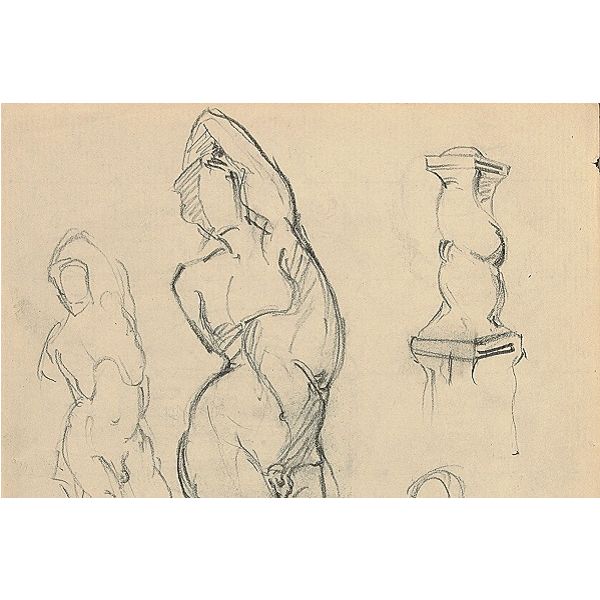
The advent of abstraction is a defining moment in art history as we devise divisions between representational, figurative, and abstract art, with the need arising from this pivotal formal shift in the modern world. The term ‘figurative’ has come to represent an antithesis of sorts to the term abstract. One is representational of reality, the latter a derived (abstracted) representation or even non-representational (colour-field paintings for example).
Learn More -
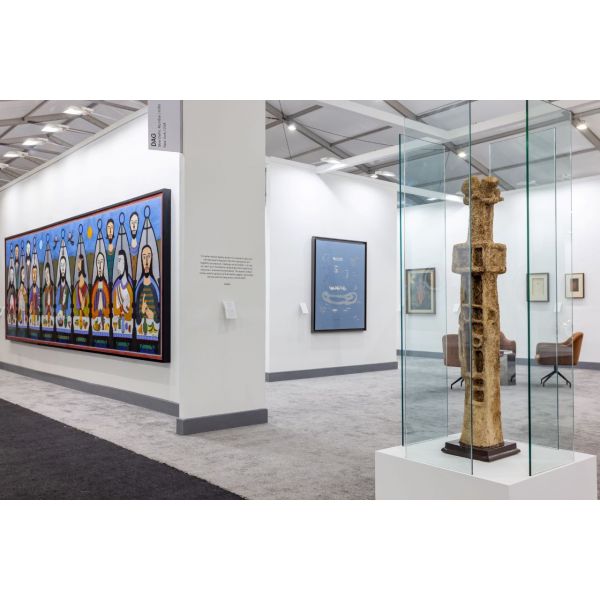 JournalModernists In Focus: Art Festivals, Early 2023$0.00
With the cultural calendar being packed till spring, join us as we travel through some of the most popular ongoing or upcoming art fairs and biennales. Take a close look at artists who bring modernist ideas to the contemporary art context. With some ubiquitous names from the twentieth century art world accompanied by a few of those that have been historically overlooked, discover how ideas around the Modern have evolved through these fairs and biennales, as we focus on notable artists from each art festival and delve into their practice.
Learn More -
-
 JournalA Child, the Youth, now Man by Rameshwar Broota$1.00
Painted in 2003 by Rameshwar Broota and titled A Child, the Youth, now Man, is bisected horizontally by a hyper-realistic finger, which partially covers a comparatively hazy vertical male torso. The evocative cruciform structure of this composition, possibly alluding to ideas of masculinity, corruption and persecution, also aides the artist in highlighting human vulnerability. There is no face visible here, only an unprotected body.
Learn More -
 JournalToits (Rooftops) by S. H. Raza$1.00
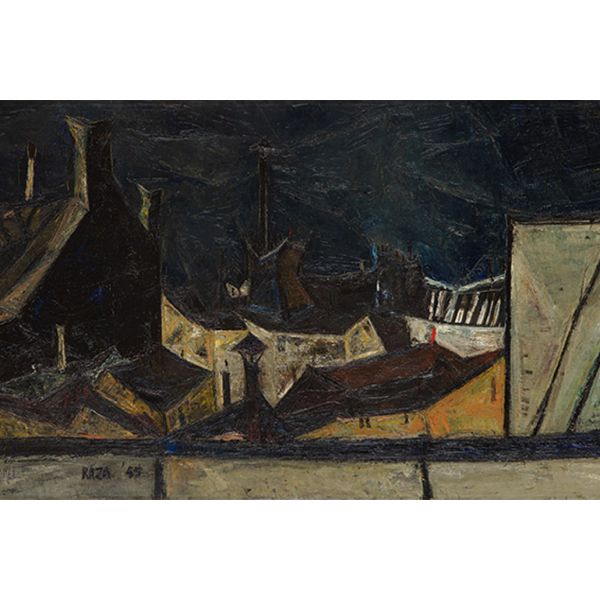
S. H. Raza had begun to paint using oils, moving away from his impressionistic watercolours, on his way to winning the prestigious critics’ award in 1956. Just a year before, he completed a stunning painting of Parisian rooftops, revealing not a daylight scene but one of the night, only yellow lamplight from the streets dimly silhouetting the chimneys and sloping roofs. This period of Raza’s career is somewhat lesser known than his later, tantra-inspired works, as Ashok Vajpeyi and Aman Nath explain to us.
Learn More -
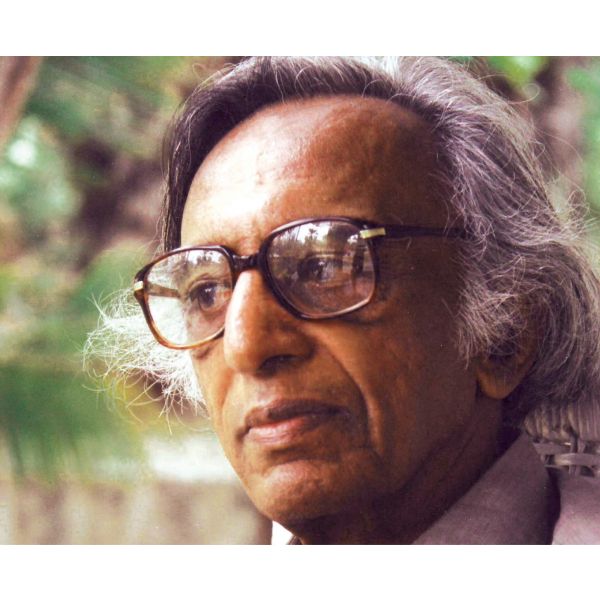 ArtistsTyeb Mehta$0.00It is ironical that works by Tyeb Mehta, who did not attach much merit to the financial value of art, were the first by a living Indian artist to sell for more than Rs 1 crore, and, soon, for more than a million dollars, indicating a beginning of interest in Indian art in the international market. His works Celebration, Kali and Mahishasura marked the beginning of the boom in the Indian art market at the start of this century. Learn More
 -
 ExhibitionsThe Seventies ShowAs low as $1.00
The 1970s was a decade like no other for a young India gaining in confidence nationally as well as on the global firmament. In 1971, Prime Minister Indira Gandhi led the country to a decisive victory against Pakistan, leading to the creation of Bangladesh. The Green Revolution had borne fruit, and Operation Flood now launched a milk revolution in the country, and the culmination of the privy purse turned it into a socialist republic with a strong handle on its economic button. Internationally, much was made of India’s resilience, and the country’s soft power began to win it recognition for its films, fashion, food and culture. India had arrived. ALTAF AMBADAS AMITAVA AVINASH CHANDRA BIKASH BHATTACHARJEE BIREN DE BIRESWAR SEN ERIC BOWEN F. N. SOUZA G. R. SANTOSH GANESH HALOI GOGI SAROJ PAL INDRA DUGAR J. SULTAN ALI J. SWAMINATHAN K C S PANIKER K. K. HEBBAR K. LAXMA GOUD KRISHNA REDDY LAXMAN PAI M. F. HUSAIN MADHVI PAREKH NAVJOT ALTAF P. T. REDDY PARITOSH SEN PRABHAKAR BARWE PRODOSH DASGUPTA PROKASH KARMAKAR RABIN MONDAL RAJENDRA DHAWAN RAM KUMAR S G VASUDEV SATISH GUJRAL SHANTI DAVE SHYAMAL DUTTA RAY SOHAN QADRI TYEB MEHTA V. VISWANADHAN ZARINA HASHMI
Learn More -