


Search results for: 'real a boliviano hoy'
-
 JournalA Child, the Youth, now Man by Rameshwar Broota$1.00
Painted in 2003 by Rameshwar Broota and titled A Child, the Youth, now Man, is bisected horizontally by a hyper-realistic finger, which partially covers a comparatively hazy vertical male torso. The evocative cruciform structure of this composition, possibly alluding to ideas of masculinity, corruption and persecution, also aides the artist in highlighting human vulnerability. There is no face visible here, only an unprotected body.
Learn More -
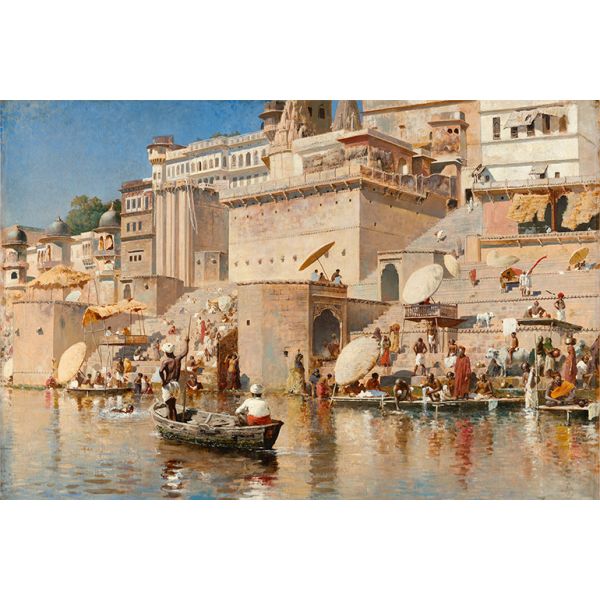 JournalOn the River Ganges, Benares by Edwin Lord Weeks$1.00
Let us take a moment to appreciate this magnificent riverside scene that can be instantly recognised as a view of Benares by the distinctive steep steps, or ghats, running down to the Ganga. American artist and Orientalist Edwin Lord Weeks had a remarkable ability to create an impression of a real-time scene unfolding before viewers, enhanced by the subtle plays of light and colour. A prolific artist who created a visual diary of his travels through his paintings—of which his India works are arguably his finest with an appeal that has transcended time.
Learn More -
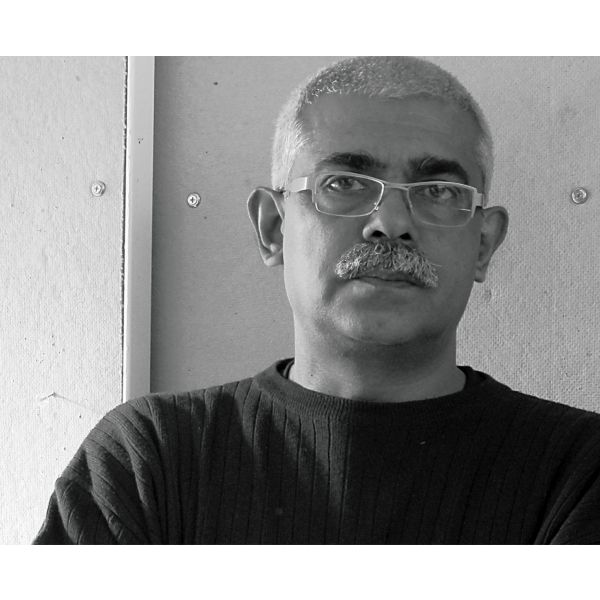 ArtistsSurendran Nair$0.00Born in Onkkoor, Kerala, Surendran Nair graduated in painting from College of Fine Arts, Trivandrum, in 1982, and studied printmaking from M. S. University, Baroda, in 1986. Nair began his art practice with strongly realist pen and ink drawings, etchings and lithographs, and commemorated people from his immediate surroundings or literary heroes in his portraiture. Learn More
 -
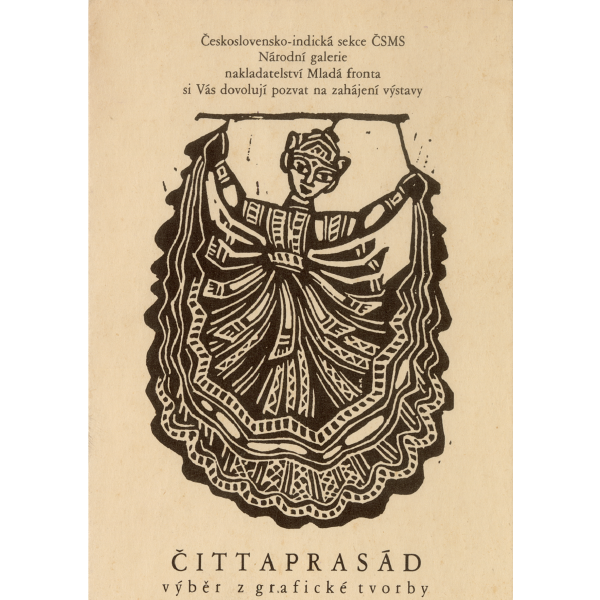 Collection StoriesAfter the Storm: Chittaprosad’s late oeuvre$0.00
Chittaprosad Bhattacharya (1913-1978) was a versatile artist and a lifelong adherent of the socialistic worldview. In 1943, he traveled across the famine-stricken villages of Bengal and produced realistic sketches of human suffering that were regularly published in the pages of the Communist Party journal 'People’s war'. These sketches were later compiled and published as a booklet under the title 'Hungry Bengal'. Fascinated by his artistic skills, the General Secretary of Communist Party of India, Puran Chand Joshi took Chittaprosad to the Party’s headquarters in Bombay (now Mumbai).
Learn More -
 Art FairsArt Dubai$0.00
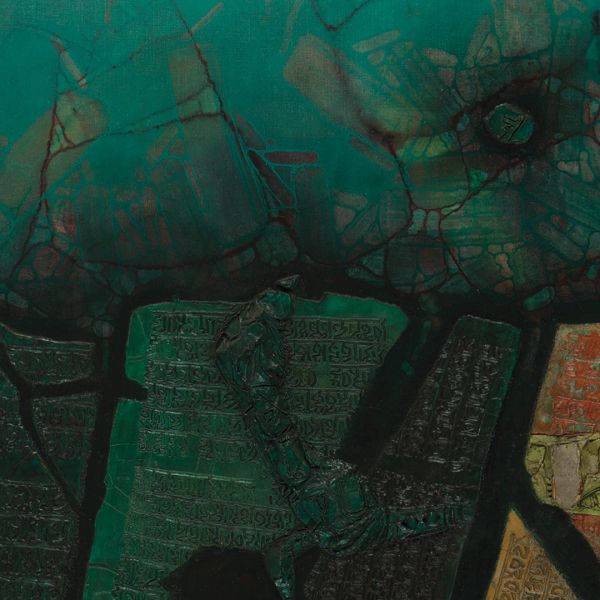
Shanti Dave’s abstracts resemble—at first—the familiar and the unknown. There are writings, figures, deities, forms and shapes that resonate with what we seem to know. If the language is indecipherable, perhaps it belongs to some ancient texts lost to history. Is this his ode to a civilisation that existed in the past, or a prophesy of one to come? Is it a world hidden underwater? Or perhaps one alien to us because it comes from some other planet? Are these tombstones, or markers, of some mythological or historical realm?
Learn More -
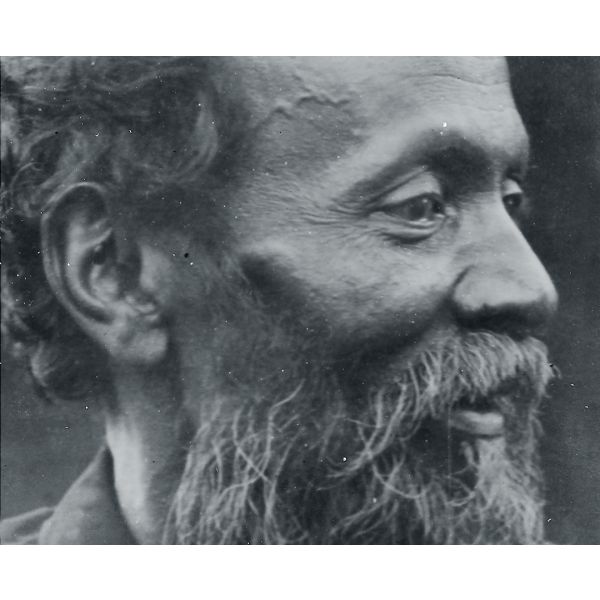 ArtistsAbalal Rahiman$0.00Abalal Rahiman was born in Kolhapur, Maharashtra, as Abdul Aziz in a family traditionally involved in making artistic manuscripts of the Quran, and is best remembered for his academic-realist landscapes and portraits. Learn More
 -
 ExhibitionsRabin Mondal: Kingdom of ExileAs low as $1.00
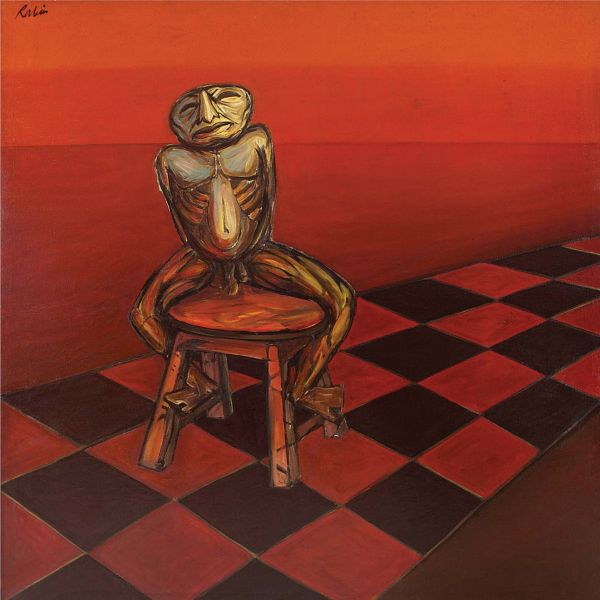
Rabin Mondal is like a striding colossus of our times, scorching up the firmament with images that reflect societal malaise and his own inner turmoil. His determination to paint in a market-unfriendly manner is characteristic of his resolve. His canvases provide no safety net for the unwary viewer. Here is a confident artist aware of his self and his role with no fig leaf to offer those seeking beauty in art—not that his work is unbeautiful.
Learn More -
 ExhibitionsIndia ModernAs low as $1.00
Any new exhibition brings with it a frisson of excitement, but by any measure India Modern: Narratives From 20th Century Indian Art has been extra special. Most art lovers take Indian modernism for granted—but how many can truly claim to know what it really means. For too many years, the term has been loosely used, with very little awareness of what it includes, or omits. What the West understands and takes as a given is something that in India still remains a mystery, perhaps because art in India cannot strictly be viewed from the same trope as Western art. Perhaps this is true of most countries, but it is especially true of colonised nations where new engagements with art in the West were imposed without the benefit of growing their own local practices organically. This hybrid custom developed at various levels, which makes it exciting when viewed from some distance, but also imposes a challenge. Therefore the question: What does modernism in Indian art imply? Akbar Padamsee Ambadas Anjolie Ela Menon Avinash Chandra B. Prabha Bikash Bhattacharjee Bimal Dasgupta Biren De Dhanraj Bhagat Dharamnarayan Dasgupta F. N. Souza G. R. Santosh Ganesh Haloi Ganesh Pyne George Keyt Gieve Patel H.A. Gade Himmat Shah J. Sultan Ali J. Swaminathan Jehangir Sabavala Jeram Patel Jogen Chowdhury K. G. Subramanyan K. H. Ara K. K. Hebbar K. S. Kulkarni Krishen Khanna Laxman Goud Laxman Pai M. F. Husain Manjit Bawa P. Khemraj P.T. Reddy Rabin Mondal Ram Kumar S. K. Bakre S.H. Raza Sakti Burman Sohan Qadri Somnath Hore Sunil Das
Learn More -
 Art FairsFRIEZE MASTERS LONDON$1.00
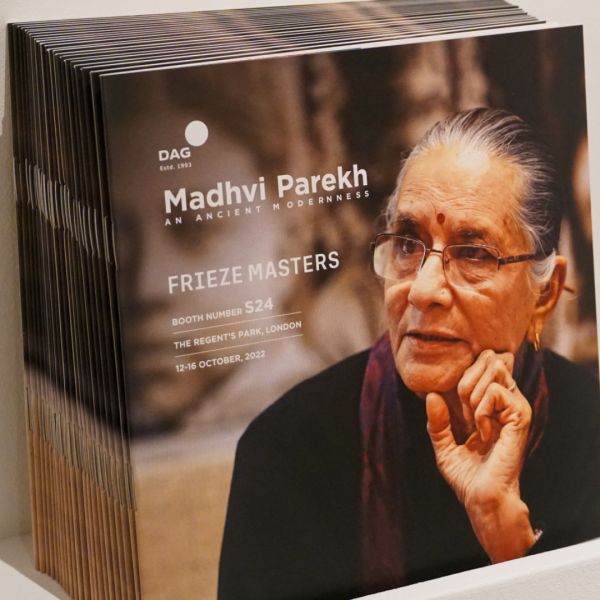
January 2022 marked an incredible culmination in the life and career of Madhvi Parekh whose journey began from a small village in western India and has taken her, against incredible odds, to the world’s most glittering cities and capitals on the strength of her art practice. At the Paris Haute Couture Week in January, audiences around the world saw Dior launch its new spring/ summer 2022 range against striking tapestries inspired by her paintings made over a six-decade career that has had no parallel in Indian art. Often extolled as a ‘woman’ painter, Madhvi Parekh’s art has never been premised on gender. Instead, she occupies an artistic realm with strong ethical values based on a sense of humanitarianism, environmental inclusion, and memory.
Learn More -
 ExhibitionsThe Babu and the BazaarAs low as $1.00
Calcutta, flourishing with commerce and maritime trade during the nineteenth century, was regarded as the ‘second city’ of the British Empire. People thronged there in large numbers to make a livelihood, or in holy pilgrimage, seeking blessings at the Kali temple at Kalighat that had been re-built in 1809. Annada Prasad Bagchi Bamapada Banerjee B. C. Law C. W. Lawrie Kshetradas Chitrakar Panchanan Karmakar Madhav Chandra Das Ramadhan Swarnakar Ganganarayan Ghosh Nritya Lal Datta Press Kristohurry Das Chorebagan Art Studio Kansaripara Art Studio Calcutta Jubilee Art Studio Bat-tala
Learn More -
 ExhibitionsDAG at Serendipity Goa 2016As low as $1.00
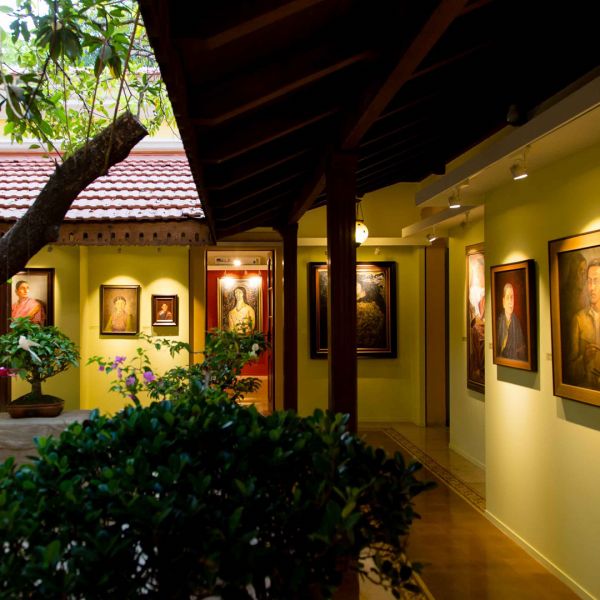
By the end of the century, however, the scene was changing, and infrastructure—following the economic reforms in 1991—began to improve, creating an interest in collecting art. Twentieth century Indian modern art has since been at the forefront of collecting and investing in Indian art, and DAG, which has the largest private collection of Indian art has a marked focus on this period of Indian art. Ambadas F. N. Souza G. R. Santosh George Keyt Jamini Roy K. K. Hebbar Kanwal Krishna Laxman Pai M. F. Husain M. F. Pithawalla M. V. Dhurandhar Madhvi Parekh Nandalal Bose Nemai Ghosh Prokash Karmakar Rabin Mondal
Learn More -
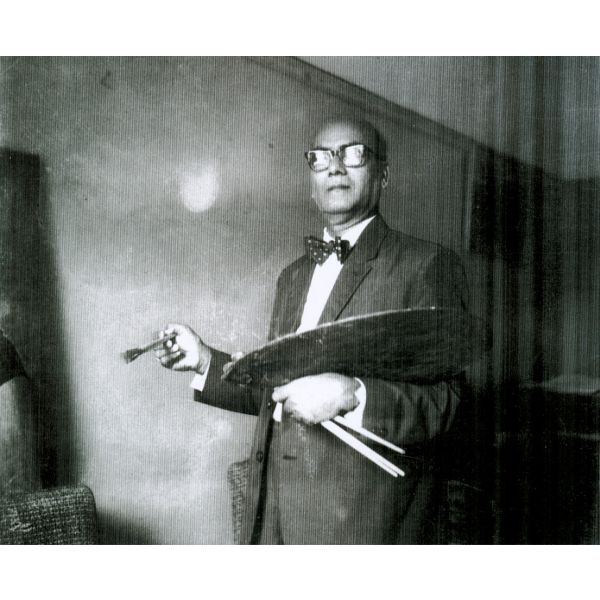 ArtistsV. B. Pathare$0.00Known for his portraits and landscapes rendered in academic-realist style, V. B. Pathare studied painting under S. L. Haldankar in Bombay and Prof. Martin Latuterburg in Bern, Switzerland. After studying portraiture under the renowned Sir Charles Dugdale in London, Pathare painted portraits of several national leaders over time, from Mahatma Gandhi, Rabindranath Tagore and Mahatma Jyotiba Phule to Indira Gandhi and Maharaja Sayajirao Gaekwad of Baroda. Learn More