


Search results for: 'Sanat Chatterjee death anniversary exhibition Gaiety Theatre early 2000'
-
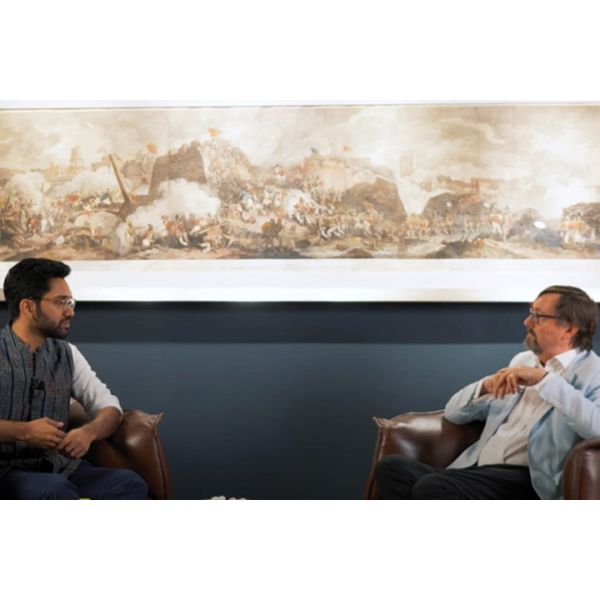 JournalRemembering Tipu Sultan: Manu Pillai and Giles Tillotson$0.00Historian and author Manu S. Pillai in conversation with art historian and curator Giles Tillotson on the subject of Tipu Sultan in the context of DAG’s exhibition, 'Tipu Sultan: Image and Distance' Learn More
 -
 JournalBefore the Chaos of Destruction: Jeram Patel's Iconic Works$0.00
Artists often proceed through a trial and error method—an incessant experimentation—leaving behind a singular trail of oeuvre composed of an irreconcilable, yet inseparable, set of works. Born in the small town of Sojitra in the Kheda district of Gujarat, Jeram Patel studied drawing and painting at Sir J. J. School of Art, Bombay. In 1959, excellence in his work led him to pursue commercial design at Central School of Arts and Crafts, London, on a scholarship, and also travel to France and Japan. Thereafter, he successfully held solo exhibition at various places in India and abroad, and participated in international events such as the Tokyo Biennale and Sao Paulo Art Biennale (both in 1963).
Learn More -
 ExhibitionsThe Fifties ShowAs low as $1.00
The twentieth century was marked by two important decades—the 1910s, when the Bengal School saw the establishment of a revivalist practice that came to signify Indian modern art in general; and the 1950s, when a newly independent nation put its colonised past behind it and embraced a triumphant modernism. A. A. RAIBA ADI DAVIERWALLA AVINASH CHANDRA BABURAO SADWELKAR BADRI NARAYAN BIREN DE CHITTAPROSAD D. P. ROY CHOWDHURY DEVYANI KRISHNA DHANRAJ BHAGAT G. R. SANTOSH GANESH PYNE HAREN DAS Indra Dugar J. SULTAN ALI JYOTI BHATT K C S PANIKER K S Kulkarni K. G. SUBRAMANYAN K. K. HEBBAR KANWAL KRISHNA KISORY ROY KRISHEN KHANNA KRISHNA REDDY Laxman Pai M. F. HUSAIN MOHAN SAMANT NANDALAL BOSE NIKHIL BISWAS P. T. REDDY PARITOSH SEN S. H. RAZA S. K. BAKRE SAKTI BURMAN SHANTI DAVE SUNIL DAS SUNIL MADHAV SEN VISHWANATH NAGESHKAR
Learn More -
-
-
 JournalIn the Snows of Kashmir by G. R. Santosh$1.00
G. R. Santosh created a hugely accomplished career without formal training in art. His abstract paintings made in the early 1960s had Kashmir as his muse, and often used encaustic and beeswax—a process he learned from Shanti Dave. Architect and designer Pinakin Patel shares his views about In the Snows of Kashmir, Santosh’s masterful painting with textural relief in a monochrome palette.
Learn More -
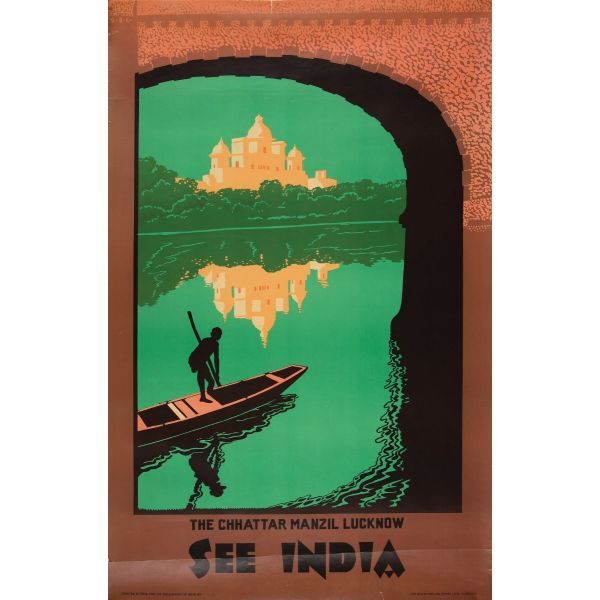 Events and ProgrammesFont, Form, Function$1.00
A workshop on typography and the art of font-making, facilitated by Diptanshu Roy, Creative Director (Wunderman Thompson) and Musician, inspired by the poster art of early 20th century.
Learn More -
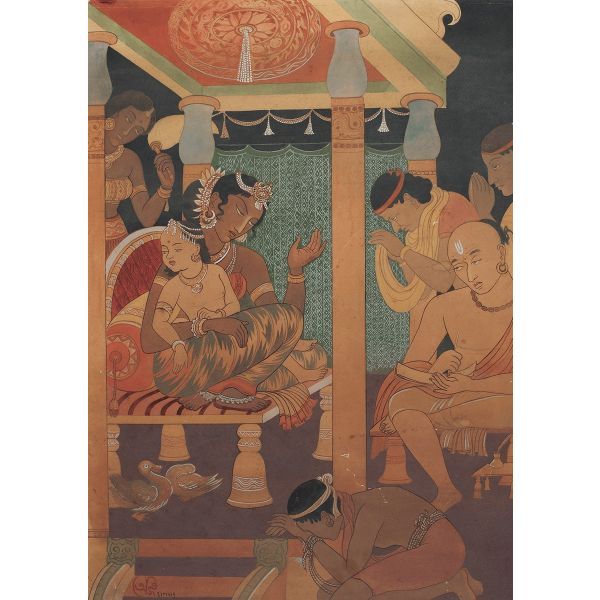 Collection StoriesSYNCRETISM IN BENGAL ART$1.00
As a region that is home to many religions and cultures, South Asia has been a fertile ground for art that blends different styles, ideas, and influences. Conquest, migration, or friendly exchange of cultural ideas and values—be it in the visual arts, food, or politics—all played a part in shaping the region as a melting pot of civilisations. Explore artworks that showcase this syncretic legacy from DAG's museum collection—starting with the early encounters with European realism, the pan-Asian influences on the Bengal School, and beyond.
Learn More -
 Collection OnlineTHE WASH TECHNIQUE$1.00
The wash technique has come to be associated in India with the art of the Bengal School, but the story of its origins in India takes us back to an era of rich cultural exchanges. In the early twentieth century artists like Abanindranath Tagore were trying to imagine a pan-Asian cultural identity, and they turned for inspiration to traditions from across Persia to Japan. Rabindranath Tagore's friendship with Okakura Kakuzō occasioned the arrival of several Japanese artists in Kolkata, such as Yokoyama Taikan, Hishida Shunsō and Katsuta Shōkin. While the latter found inspiration in the Hindu epics, artists in Bengal adapted techniques that were used by the Japanese, such as the wash technique or the subtle use of ink and brush. Since then, the wash technique has been interpreted widely by individual artists, offering an ethereal quality of light to their works, or, in some cases, like for Gaganendranath Tagore and Prosanto Roy, new possibilities of painting in various shades of darkness.
Learn More -
 Events and ProgrammesE Ek Ashcharja! Kalikata Kalankini; Athaba Chaaper Naksha Prahasan$1.00
Art Lab is travelling pop-up exhibition on Indian modern art, that transforms classrooms into museums and creates an immersive, participatory learning environment for learners.
Learn More -
 Events and ProgrammesE Ek Ashcharja! Kalikata Kalankini; Athaba Chaaper Naksha Prahasan$1.00
Art Lab is travelling pop-up exhibition on Indian modern art, that transforms classrooms into museums and creates an immersive, participatory learning environment for learners.
Learn More -
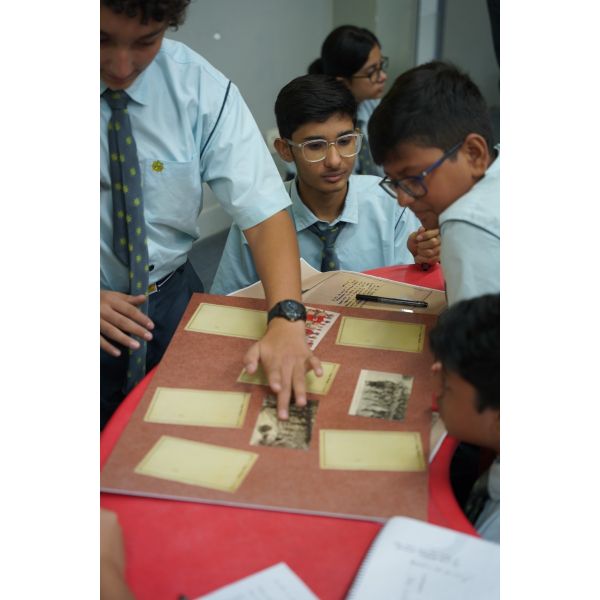 Events and ProgrammesArchive Case Files: School Edition$1.00
Art Lab is travelling pop-up exhibition on Indian modern art, that transforms classrooms into museums and creates an immersive, participatory learning environment for learners.
Learn More