

Remembered Cities: Place-making with Gulammohammed Sheikh
Remembered Cities: Place-making with Gulammohammed Sheikh
Remembered Cities: Place-making with Gulammohammed Sheikh
Encountering the work of Gulammohammed Sheikh often feels like following a narrative through a series of visual puzzles. Moving from one image to another, we encounter historical references, fragments of different stories, and familiar places that gradually become sites where histories begin to unfold. His works ask us to look closely, recognise particular fragments, and consider why certain images have been brought together.
At the heart of this process is Sheikh’s technique of image quotation: by placing a historical image within a new visual context, he allows it to acquire new meanings and relationships without erasing its earlier associations. Quotation thus becomes an act of dialogue, in which an image carries its past into the present while participating in the formation of something new. This process of recontextualisation—of reversal, rupture and unexpected connection—also resonates with the mysticism that informs Sheikh’s practice. His adoption of digital techniques has extended these possibilities further, allowing images to be layered, recombined and placed into ever more complex networks of visual and historical relations.

|
Gulammohammed Shaikh, Whose Kashmir? (detail), 2005, Digital collage and inkjet print on Arches paper in accordion book format, 11.7 x 296.0 x 0.2 in. Collection: DAG |
These aspects are quite evident in Walled City II (2004) and Whose Kashmir? (2005), both of which are on display as part of DAG’s ongoing exhibition Freedom to Form: Baroda Modern. Created just a year apart, the two works begin from different scales of place: Walled City II takes the city as its point of departure, while Whose Kashmir? expands outward into a broader cultural landscape. Yet both are shaped by a deeply personal impulse to hold on to places, images, histories and cultural memories that might otherwise disappear. Sheikh’s paintings become repositories of these encounters, keeping fragments of the past present while allowing them to enter new relationships with one another. In looking at them, we are invited into the artist’s own mode of remembering—a process in which memory is not fixed or nostalgic, but continually reconstructed through the layering of images and histories. His response to forgetting is therefore not a rejection of modernity, but an effort to bring different histories, visual languages and temporalities into conversation.

|
Gulammohammed Shaikh, Whose Kashmir? (detail), 2005, Digital collage and inkjet print on Arches paper in accordion book format, 11.7 x 296.0 x 0.2 in. Collection: DAG |
Sheikh’s relationship with Kashmir can be traced in part to his years in Baroda. During his time at the Faculty of Fine Arts, he shared lodgings for a period with Ghulam Rasool Santosh, the Kashmiri artist and poet. This connection offered a personal link at a formative stage. His engagement was also nourished by reading and by the accumulation of images and histories through which the region could be imagined. By the time he came to make Whose Kashmir? Kashmir was not simply a geographical subject. It had become a space through which different histories, faiths, artistic traditions and memories could be brought together. He does not approach a place only through what can be physically seen but through the images, stories and histories that have accumulated around it.
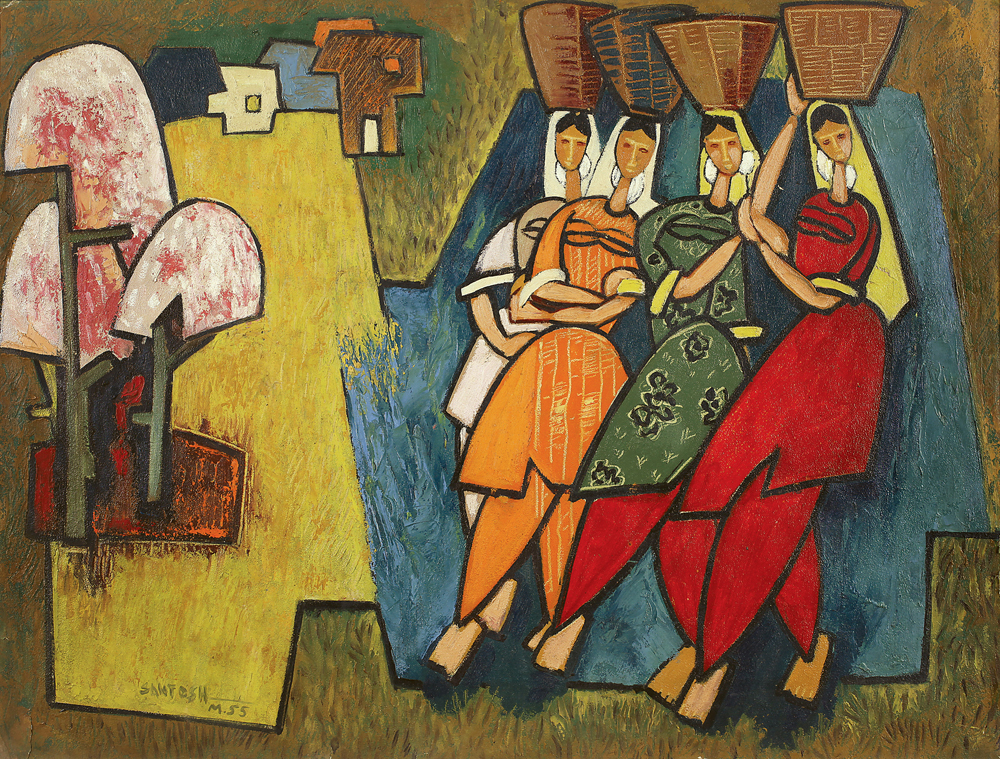
G. R. Santosh, Untitled, 1955, Oil on paper pasted on canvas, 22.0 x 30.0 in. Collection: DAG
His art historical knowledge matters too. His encounter with European art, including travels in Italy, brought him close to Sienese painting which he regarded as a longstanding ‘touchstone’. This history of looking helps explain why images from apparently distant traditions can sit together within his compositions. For instance, in Whose Kashmir?, one finds a face rendered in the style of Sienese art amidst the broader milieu of Kashmir, along with other historical figures who join the scene through their association with Persianate and Buddhist art. This is not merely an aesthetic gesture but one of the image quotations Sheikh makes available through his work. An image brings its past into the present through dialogue.

Gulammohammed Shaikh, Whose Kashmir? (detail), 2005, Digital collage and inkjet print on Arches paper in accordion book format, 11.7 x 296.0 x 0.2 in. Collection: DAG
One more aspect of such an understanding of a place is drawn from the miniature tradition, specifically the Persian miniatures. Sheikh draws on the miniature not just in terms of its themes or imagery, but also because the miniature has the capacity to construct an entire world within a pictorial world. At the same time, the miniature alters our perception of scale because humans are very small elements within an enormous world of landscape, architecture and history. Through this relation, Sheikh establishes that humans are simply a tiny element in a larger world, while at the same time making a small personage carry an enormous amount of history. Tiny figures of scholars, dervishes and other characters occupy the extensive landscapes in Whose Kashmir? They are very small physically, yet very big historically. This requires the viewer to shift his gaze from one thing to another.

|
Shahnameh - The Div Akvan throws Rustam into the sea. Image courtesy: Wikimedia Commons |
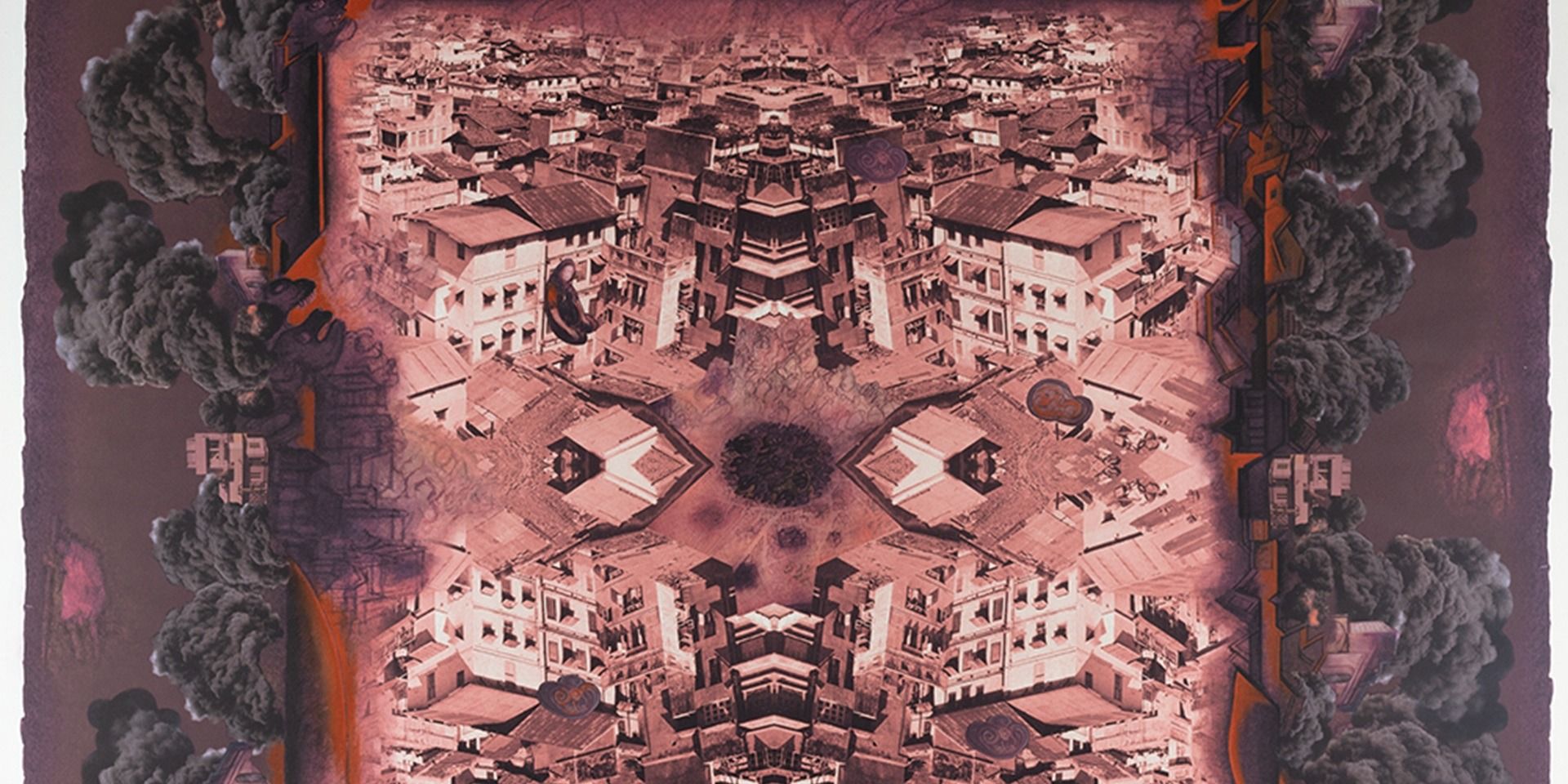
Walled City – II is created by Sheikh using an existing city that is already filled with history. This artwork was created in 2004 and it is a digital collage with gouache on inkjet paper. At the centre of the painting there is a historical photograph of an urban landscape from above showing dense roofs of a built-up urban space, typical of Ahmedabad during the communal riots of 1969. This historical picture is then mirrored along the two axes of the composition creating a kaleidoscopic arrangement, while further elements, such as drawn architecture, clouds and figures, are added to this composition. The mirror work is very important for this composition because the city depicted in this photograph is not only multiplied but it also loses its singularity. The same architecture, same densely built spaces and the same urban environment repeat themselves.
The effect could be described as kaleidoscopic, yet it is not just ornamental. Through repetition, the violence appears to be embedded into the environment of the city. Violence is no longer seen as a rare phenomenon that occurred at some distant point in history; Sheikh’s visual rendering shows how it might be integrated into the environment of daily life. That is where Sheikh’s concept of ‘an image upon another image’ proves very helpful. The photograph is one layer of history; the reflected image is another; Sheikh’s drawings yet another. The city becomes a composite picture rather than a documentary record.

Gulammohammed Sheikh, Walled City – II, 2004, Digital collage and gouache on inkjet paper, 49.2 x 58.0 in. Collection: DAG
While Walled City – II creates a single image that contains the memory of a whole city, Whose Kashmir? broadens the idea to an entire landscape. Created in 2005, Whose Kashmir? is a massive digital collage made with inkjet print on Arches paper as a book-style accordion work. It stretches for nearly twenty-five feet, and the format is significant as the work needs to be viewed section by section in order to reveal Kashmir step by step. The title raises a question – Whose Kashmir? While Sheikh does not answer the question with any single history, he creates Kashmir out of multiple ones. In the first section, the Div Akvan from Shahnameh, who usually holds Rustam, becomes a carrier of the land instead. The rugged land he holds turns into miniature Kashmir filled with images of Hazratbal Shrine, Shankaracharya Temple, Buddhist monasteries of Ladakh, chinar trees, scholars, Sufi dervishes who perform sama, Buddhist deities of Chakrasamvara and Vajravarahi.
The chinar takes this concept one step further. Here, the branches of the chinar take the form of a live archive, with tiny portraits of poets, scholars and religious people depicted within the vegetation. Different traditions do not have their own separate spaces; they grow out of the same tree. Throughout the development of the work, Sheikh transitions through traditions that would usually be considered independently. The Persian miniature, the Buddhist imagery, the Sufi tradition and modern violence are all part of the same visual language. One element of the work is based on Farid al-Din 'Attar's Mantiq al-Tayr, or The Language of the Birds, especially the Funeral Procession in a manuscript dating back to 1486. In this work, the son laments the death of his father while the Sufi comforts him. Placed within Whose Kashmir? the historical artwork is now part of a meditation on memory, loss and time. The work then suddenly changes and shows a large number of firearms, including AK-47s, arranged in the form of a mushroom cloud.
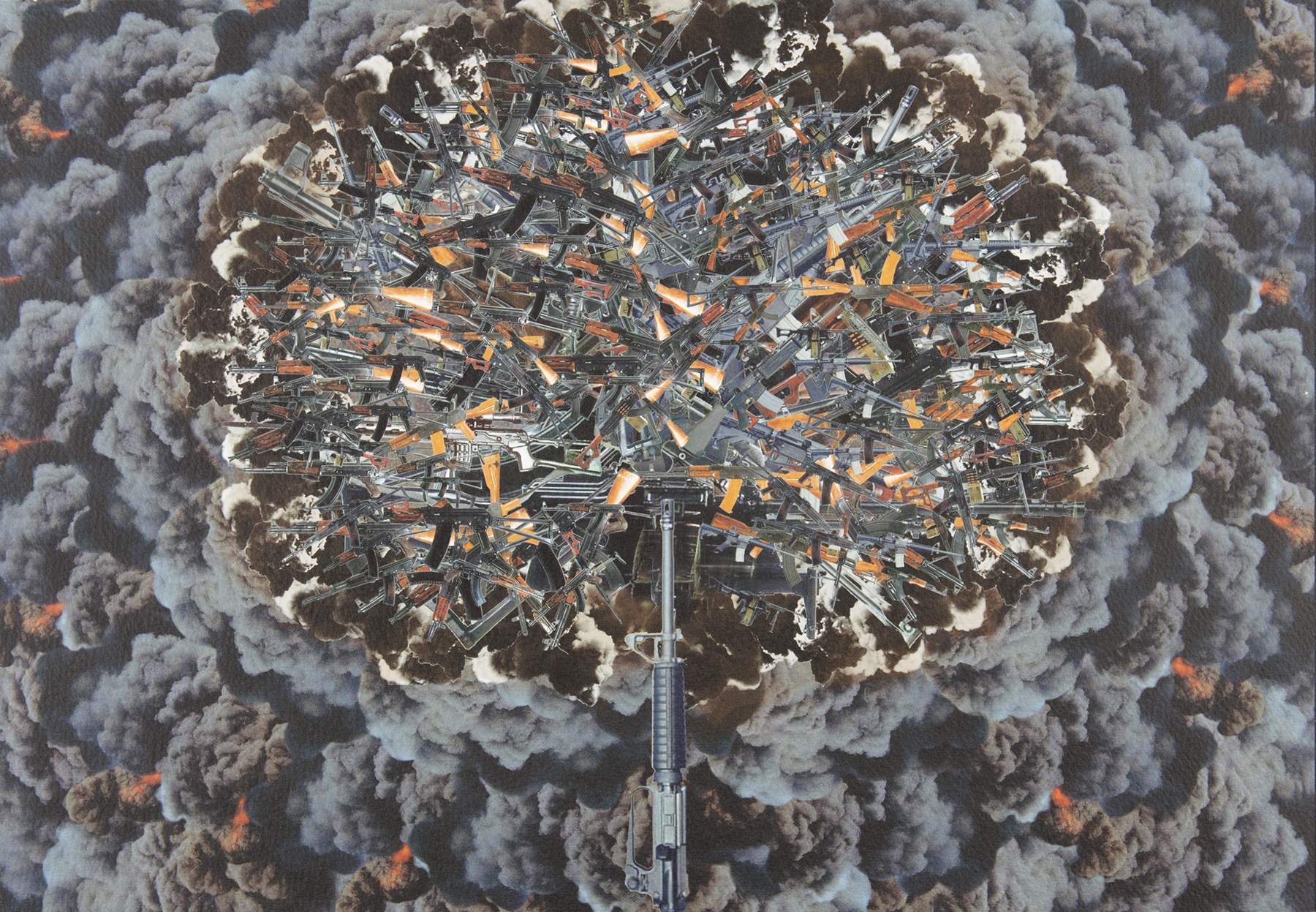
Gulammohammed Shaikh, Whose Kashmir? (detail), 2005, Digital collage and inkjet print on Arches paper in accordion book format, 11.7 x 296.0 x 0.2 in. Collection: DAG
The passage that focuses on the Ebstorf Map is an illustration of this point. The mappae mundi created by Sheikh draw inspiration from medieval world maps created in Europe and in Whose Kashmir? Sheikh uses the structure of the Ebstorf Map–a medieval Christian map–to create an intricate image using references to Asia and Buddhism. This is crucial because the Ebstorf Map illustrates one of the systems used historically for imagining the world, whereas Sheikh creates an intersection of it with visual and spiritual traditions from Asia. It does not imply the rejection of one tradition in favour of another one, but rather a dialogue between different ways of seeing and organising information. The same applies to the moment when Sheikh creates an image of his map over the picture of Srinagar depicted in a nineteenth century pashmina shawl.

Photo of a reproduction of the Ebstorf Map, with east at the top. Image courtesy: Wikimedia Commons
The map always tells us something about location. Sheikh’s maps pose a new question: How did we learn to locate ourselves? This is the question at the centre of Sheikh’s conception of place. The place is not just a matter of geography, but it is the product of the systems through which people map, name, recall and tell stories about it. That is why for Sheikh writing and painting are so tightly bound. He argues that their connection is very important and that the division of them, which is typical for the modern world, should be critiqued. Neither seeing nor reading are singular actions: the picture evokes associations, and words bring up images. Whose Kashmir? works almost like a text without becoming its illustration. It consists of characters, transitions, repetitions, historic allusions and interruptions. We read it through our eyes. The structure of the accordion strengthens this process: in each new opening, we find a new part of the story, while the previous image is still remembered.

Embroidered wool map-shawl, Kashmir, India, third quarter of the 19th century. 90 x 78 in. Collection: Victoria and Albert Museum, Gift of Mrs Estelle Fuller through The Art Fund
This takes us back to the broader theme of Sheikh’s interest in memory. His practice can be understood as an ongoing process of reclaiming and reimagining the past, working against the historical amnesia that accumulates over time. Within this framework, Kabir becomes a particularly resonant figure. Towards the end of Whose Kashmir?, Kabir appears within an image of a vessel that seems to contain an aggregate Kashmir—a place constituted through the accumulation of histories, cultures and memories. Sheikh invokes Kabir as a figure whose significance has endured across centuries, and as someone who was neither a conventional preacher nor an advocate of divisions between communities. His presence is therefore characteristic of Sheikh’s larger method: historical figures are not simply recalled but brought into the present as interlocutors through whom contemporary questions can be approached.

Gulammohammed Shaikh, Whose Kashmir? (detail), 2005, Digital collage and inkjet print on Arches paper in accordion book format, 11.7 x 296.0 x 0.2 in. Collection: DAG
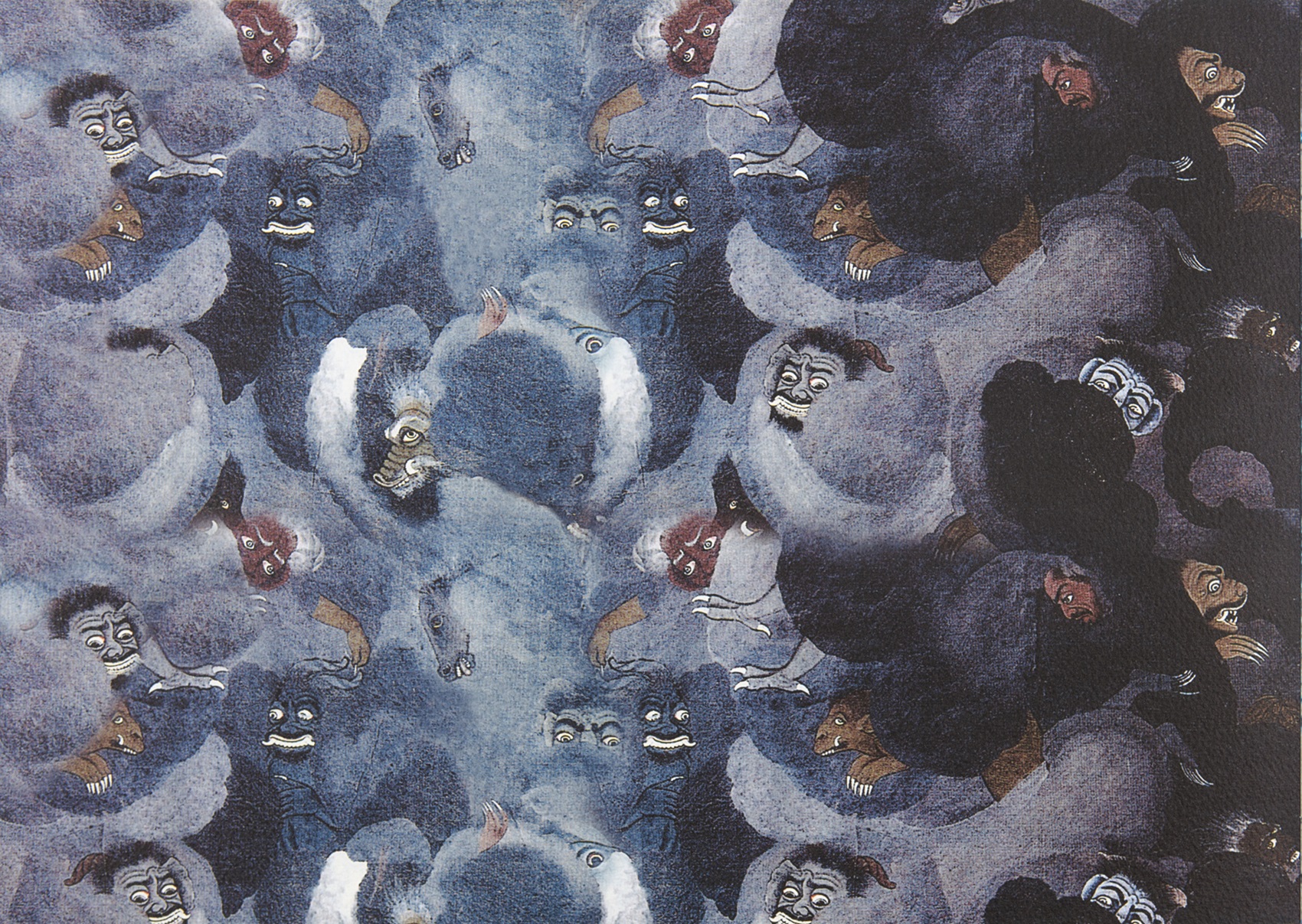
Gulammohammed Shaikh, Whose Kashmir? (detail), 2005, Digital collage and inkjet print on Arches paper in accordion book format, 11.7 x 296.0 x 0.2 in. Collection: DAG
This also brings us to the central question posed by the work’s title. Perhaps the work does not seek to answer this question at all. Instead, it gives form to Kashmir as a layered and contested cultural landscape, shaped by Buddhist, Sufi, Persianate and Hindu traditions, as well as by literary, architectural and political histories. Rather than proposing a singular Kashmir, Sheikh allows these different histories to coexist, overlap and speak to one another. The common thread that runs between Walled City – II and Whose Kashmir? is the idea of survival through memory. In the former work, the historical photograph is reflected, replicated and encased in the artist’s drawings such that it becomes something other than an archive; while Whose Kashmir? consists of maps, manuscripts, miniatures, Buddhism, Sufism, religion, architecture, historical personalities and violence.
This explains the importance of image quotation in the analysis of Sheikh’s work. Sheikh does not let the past remain behind the image; instead, he moves it into the foreground. Miniature painting does not remain only an illustration of an ancient manuscript but an illustration of the way contemporary places have been remembered; the map becomes not only a geographical document but a history of the way our world has been visualised; the historical photograph ceases to be merely proof of the happening of the event but a constituent of the memory of the city. And the viewer himself plays an active role in this process. When looking at Sheikh’s work, we enter the world created by him based on his memories, readings and encounters. We recognise some images, look for others and start to find a connection between the apparently unconnected things. Maybe this is the very thing Sheikh tries to preserve: not a single version of the place but all the elements which made this place what it was. In opposition to forgetfulness, Sheikh accumulates; in opposition to the single language of visual culture, he quotes different languages; and in this way, his places remain animated—not dead. This might be what Sheikh tries to retain in the end: not one version of the place but everything that has contributed to make it what it is. and thus, his places are always open places —not static ones of the past but ever reconstructed in each viewing.

Gulammohammed Shaikh, Whose Kashmir?, 2005, Digital collage and inkjet print on Arches paper in accordion book format, 11.7 x 296.0 x 0.2 in. Collection: DAG